Thursday, November 19, 2015

Temporary Measures

We spent another day in the mountains moving cattle. It was cold and windy. I dressed warm but not warm enough. Riding a 4-wheeler is even colder than riding a horse, except for the heated handles. Mark and I traded off driving to warm up our fingers.

The cattle moved easily except for one head. Everyone else came to meet us. T44 blue was reluctant to cross a far-off creek. Mark saw her outline from a distance and tried to impress me by correctly identifying her. I’m not easily impressed. Tell me why he knows her from a speck on the horizon and he didn't notice my new jeans?

T44 blue is 8 years old now and Mark remembers her as having her first calf as a 2-yr-old in January. She was one of three that year that were accidently bred early and calved in January instead of March and April. She’s the only one of the three still in the herd. We drove around the long way to fetch her. As soon as Mark knew who she was, he knew that her docile temperament would allow me to walk her on foot to a better creek crossing. How does he know her emotional traits and keep her straight from all the other hundreds of cows? His answer: “I’ve been around her for eight years!”  

She indeed was a nice, calm cow and Kate and I got her back with the others after a pleasant walk-about. We followed her by a spring that rises out of a bowl in the sagebrush and quickly turns into a substantial creek. Were those baby trout I saw darting from bank to bank?

super conditions for winter grazing

how Kate gets a drink

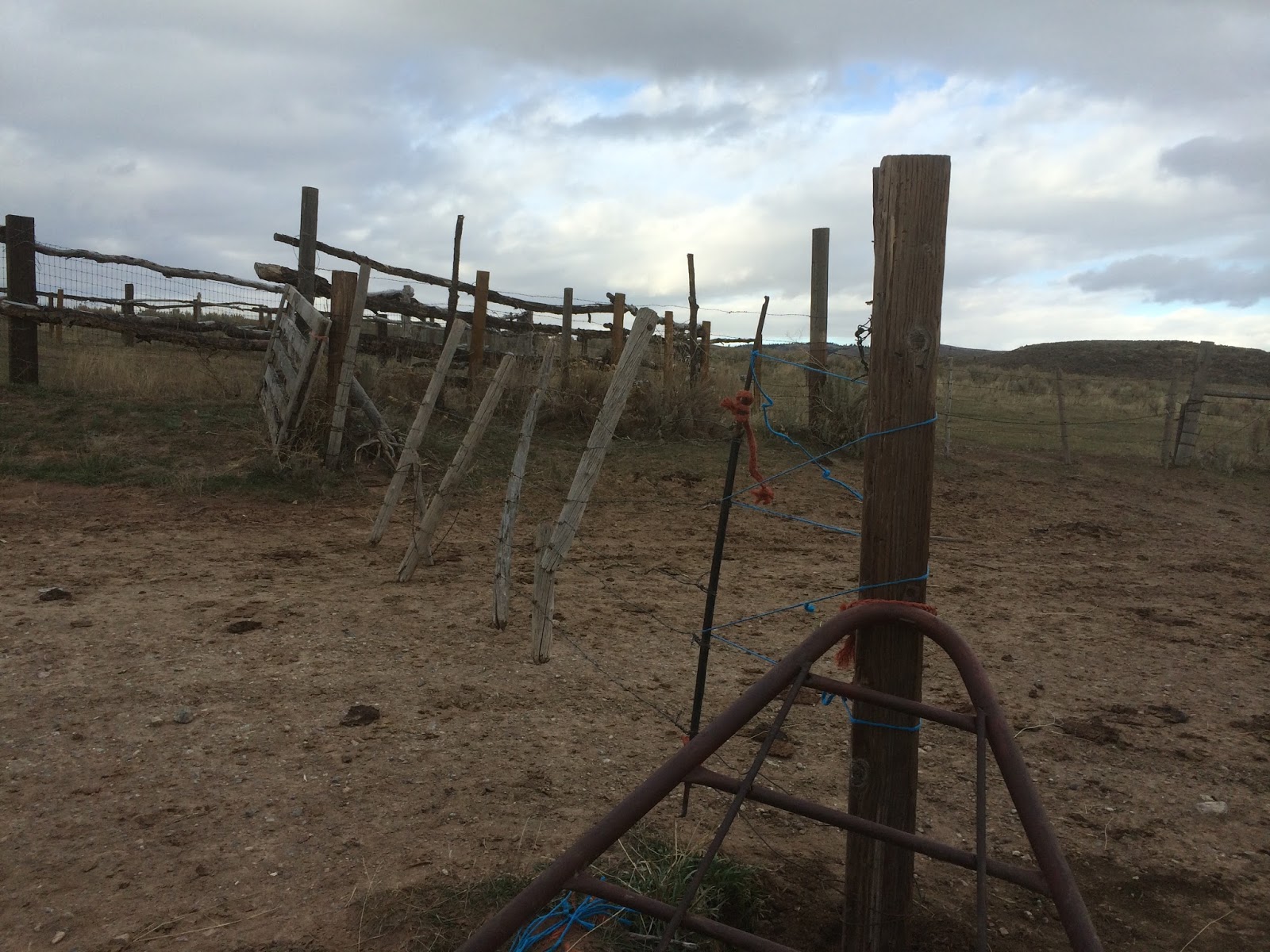
There’s always odds and ends to attend to besides the cattle and today was no exception. The lovely arch we inherited at the mountain ranch is falling over. Thank goodness Mark had delivered a stout post this summer to do the repair work. He never got to the repair, but the post was handy for what we call a “greasy sacker fix” to prop up the arch ‘til spring.


a better fix will have to wait until next year

Then on the way home we spied another gate in disrepair. We’ll need this later on when we walk the cattle home. It’s on the county road adjacent to a cattleguard. We stopped so Mark could reset a post that had been knocked over. The gate needs extended, but for now a macramé of plastic baling twine will work to connect it to the brace post at the end of the cattleguard. Like the arch, Mark called his fix a “temporary measure.” He referenced one of his favorite humorists, Patrick McManus, who says that a temporary measure is in danger of becoming a permanent measure if it lasts long enough!


using the window to hold up the wing of the cattleguard 

"our best is none too good"


Thursday, November 12, 2015

A Nuanced Season

November is a quiet month, a subtle month. And as the year gets older, the landscape looks more and more like my wardrobe – neutrals. I own one melon colored t-shirt, a red wool coat and a couple of teal tops. Everything else is brown, gray or black. Hmmm. What does that say about me?

Maybe all it says is that I think neutrals are beautiful. That nuances are beautiful. And November is nuanced for sure. Even its holiday, Thanksgiving, the start of the cluttered Christmas season, is still bathed in neutrals and subtleties. Most Thanksgiving days are mocha colored, the color of bare tree limbs. And what’s not to love about mocha?

The cows are still in the mountains. We moved them to a new pasture where tall bunch grasses reach above the few inches of snow. A little snow is fine if it doesn’t get too cold or too deep. We walk around with our fingers crossed. Every day now is a gift away from the haystack.

The calves are grazing here in the valley. We took the heifers to a pivot of wheat owned by a man who isn’t afraid to let cows on his farm, a rare commodity in our community.  A farmer willing to run the pivot after the wheat is harvested and fall fertilize. He says the calves will reprocess the fertilizer and leave it for next year’s crop. The conditions were perfect this fall for good regrowth and there was plenty of seed since a rogue hail storm put 10% of the crop on the ground before threshing. Still it's an experiment and a bit of a gamble. Deep snow or super wet conditions could derail the grazing days/acre needed to make the whole thing work. 

We’ll share the labor, and when it’s done we’ll share the figures, and hopefully it will work out to the plus side of both our ledgers.   

Mark and Jesse strung an electric wire along the pivot so that we can move the fence by rolling the pivot every couple of days to give them a fresh paddock. We call this “rationing” of stock-piled feed. Statistics say you’ll increase utilization by up to 40% doling out the forage instead of letting them have it all at once. 

So it’s about cows as it always is. And it’s about trust. And about continuing to seek new knowledge. Fitting for November when one feels reflective. When we take stock of the year behind us and think about what the next season has in store.  

calling the cows to change fields
"come on cows!"

rolling the pivot to change fields

Tuesday, November 3, 2015

Finding Doc

It was cold yesterday. I wore my coveralls all day. I’m still in my summer skin - still pumping my summer blood - so the extra layer was wonderful. I thanked Mark over and over for suggesting I throw them in the pickup.

We went to the hills to let the herd into another field. They could hear us coming on the 4-wheeler and jogged to meet us. They know the deal.

We were surprised to see an antelope in their midst. Actually, he was out in front getting the heck out of the way! We think of antelope as flatlanders; what was he doing up here in snow country?

The next job after letting the cows through the gate was hauling the bulls home from an adjacent pasture. We had left two horses, Doc and Jane, at the mountain ranch to do this very job, but when we went looking for them, we found Jane by herself. Any horseman knows this as a heartsick affair. Horses are eternally lonesome for their own kind and to go from two horses to one horse usually means disaster. My mind had him dead from a hunter’s bullet or from getting tangled up in fencing wire. We searched nearby and found nothing. Knowing that Mark’s folks were waiting at the corrals, we proceeded moving the bulls with a sick feeling.

When we got the bulls loaded and the trailers headed for home, me driving one outfit, Mark searched for Doc one more time to no avail. He had a thought, though, when he remembered a lone sheepherder’s horse next to a sheep camp due west of there. It’s on the route home. Could Doc have somehow gotten out of our pasture, traveled cross country over a ridge and attached to this horse? Turns out that’s exactly what he did. Mark spied him with the binoculars, rode Jane out in the field, slipped the halter on the visiting buckskin, and left the sheepherder’s bay to himself again.

I was already home and had delivered my load of bulls when Mark called. He was on top of a mountain where he could get cell service. I was in the garden. They were calling for a heavy frost so I was pulling the hold-out onions and beets, and cutting the last two purple cabbages. It was almost dark. What a relief to hear his good news!

I washed my produce in the light from the dining room window and laid down on the lawn. I could hear the bulls bellowing from their fall pasture just a quarter mile away, and in the background the rustle of leaves falling off the cottonwoods. I said my “thank you” to the universe and felt the solidness of the earth beneath me. My only care was that I was a day late to enjoy the hunter full moon.

they do love fresh feed

Tuesday, October 27, 2015

Through Donna's Eyes

My sister Donna moved to the east coast over thirty years ago. She went for an adventure. She didn’t really mean to stay that long, but stay she did. She’s the reason we’ve seen most of the Smithsonian museums, Gettysburg, Colonial Williamsburg, Mt. Vernon and Monticello. We’ve sailed the Chesapeake Bay, driven the Blue Ridge Mts., and strolled the boardwalks of Rehoboth Beach because of her. We’ve missed having her here these long years, but it’s enriched our lives having her home as a pinpoint on the map of the U.S.

It was her turn this year to come out west. When she pulled into our driveway she immediately started taking photographs of our freshly rained on fall-colored home site. She’s never been the one taking pictures, but with her smart phone has discovered a new hobby. Her images see our home from a different perspective.

She was here for sister retreat, our annual trip to reconnect us six sisters. This year we traveled to Salt Lake City, Utah, to the south, and Stevensville, Montana, to the north.

We viewed our grandmother’s “special collection” at the JW Marriott Library at the University of Utah. The staff had us put our bags and cell phones in a locker at the front of the collection and slip on white gloves to view the photographs put away by our grandmother many years ago for safekeeping.

We had gone to Salt Lake City for a history lesson. On our Mom’s side, we found our great grandfather’s simple grave marker among the 120,000 souls interred in the Salt Lake Cemetery. And from our Dad’s side, we searched the military rolls at Fort Douglas for a civil war soldier that played a poignant part of our history.

In the evenings we laughed in the hot tub, played Jenga, and assigned each sister the task of coming up with a one-word characteristic to describe each of us.  “Selfless,” “tough,” “eclectic,” “peacemaker,” “poised,” “over-thinker” all made the list.

We got back home and added our brother for an afternoon tour of the local graveyards looking for ancestors. Merle, my genealogically minded sis, had a list of names and photos, which along with colorful oral stories she knows by heart, made it an afternoon to remember. Bright sunshine and fall leaves scattered over the graves made the scene complete.

We’re now all immersed in our lives again. Left with the emailed images from a cell phone camera back at work selling houses in Maryland. The images, the impressions, of my East Coast sis - or as she calls herself, "our faraway sister."  

Jemmett headstone at Hillcrest Cemetery

storm over Higham's Peak

the olive and grandpa's table

fall pasture

October's freshly blooming black-eyed susans 

Reid Valley apples


Tuesday, October 13, 2015

To Everything its Season

We’ve had a string of cow-working days. Preparation for winter means weaning calves and processing individuals to update their vaccinations, and giving them their annual dose of parasiticide. The bulls are taken to their own pasture. The calves are trucked to the valley where they can eat our best feed. The adults stay in the mountains until snow forces us out.    

Ask any cowman or woman, and they’ll tell you that fall is their favorite time of year. The weather has cooled, the horseflies are gone. The mature perennial grasses are a soft, buttery color. The trees and brush go from yellow and rust to shades of grey. And when the calves come off a silence descends on the herd that’s like winter herself.  

We walked the cows to their fall pasture yesterday. They stretched for more than a mile, walking single file. Watching them this time of year, I always think of the word “resolute.” They know where they’re headed. They trust us.  

My sis rode with us a couple of days. She enjoyed it a lot, and having her along made me remember why I married a rancher in the first place. Riding horses and trailing cows was a grand activity when we were kids. And I still love it, it’s just that the burden of ownership gets in the way.  

Yesterday was near perfect. Not only was the weather sublime and the cattle willing, but we had some excitement before the day was over when we collided with a band of sheep. The big white dogs that provide predator protection to the sheep started chasing our cows. The sheep got in the action and all three species came barreling toward us scaring our horses. Kit took her frightened horse out of the melee and I got off Jane, afraid that in her fear she might remember she knows how to buck. Mark got control of his Doc horse and with the dogs got the sheep collected and away from the cattle. In a few minutes all was quiet again and the herd was safely through the gate.  

Kit has come back to riding horses. She was too busy raising kids, and working and owning a family business, to commit the time, energy, and money required to keep a horse fit. Never mind the tack and pickup and trailer to have on the side. She had an epiphany a couple of years ago when she had a rare day off and happened to ride a friend’s mare, one of those memorable horses that is kind, responsive and an absolute joy to handle. Kit remembered just how much horseback riding had meant to her as a young woman. Now she has a good, safe horse, her own saddle and her own transportation.

Most of all she has the luxury of time . . . and a post-fifty mindset that says, “it’s later than you think." Time to put first things first.

counting them through the working corrals

my sis and me

weaning day

Doc and Jane, our helpmates

before the sheep incident


Monday, October 5, 2015

Round-up

It’s not what it used to be.

We run cattle in a grazing cooperative that’s been around since 1916. My great grandmother was a founding shareholder. Mark's family also has a history in the cooperative. We've heard stories of round-up for many years. Used to be that men (and men only!) rode their horses from area to area to gather cattle together in bunches. Each owner cut his cattle from the most numerous brand of the day and trailed his group back to his grazing area. Everyone rode each allotment because with no fences the cattle could roam over large distances. It meant the cowboys stayed overnight in the mountains for 10 days or so and rode in a different direction each day.

Now we have fences that divide up the range so mixing of brands is minimized. Usually a couple of days will get the cattle collected. Other things have changed of course. It's usually done on the weekend so it doesn't conflict with town jobs. Most of us sleep in our own beds in the valley instead of throwing a bedroll on the cold ground or riding from a far off cabin before and after the day’s work.  

But some things haven’t changed. If you're less experienced you're expected to hold herd and let the real cowboys do the work of cutting out strays. Holding herd is an important job, but boring. Cutting out is loads of fun. I told Mark I’m sick of holding herd. I’ve paid my dues so let me in the herd already! It still pays to know everyone’s brand and ear tag. And for heaven’s sake cut out pairs, never singles, or you cause yourself more work by mismatched mothers and kids searching for each other. Be conscious of how your neighbors handle their cattle, keep an eye out for sick calves that need treated, and remember in the end it’s all about relationships so be respectful of one another.  

Some things have improved. Our crew on Saturday included Gary at 70 plus, the senior cowhand, and Harli, a “fuhst grader.” Harli rode with her grandma or me the afternoon we were together. We three females would not have been included in the old days. Or I dare say, even wanted.

With many hands comes light work and we gathered the high country, the low country and the in-between country in a quick hurry. Rain threatened all day but it never materialized. Just those incredible angry skies to pull our eyes to the beauty beyond the mountain tops.

I'm trying to instill a habit of saying “thank you Lord” throughout my days. Some days are better than others. Round-up day was a “better” day.  Especially since I got to cut.  


Friday, October 2, 2015

Mindfulness

September slipped away last night. That was fast.

I read that if we want time to slow down (don’t we all?) then we need to quit rushing from one thing to another, stuffing more and more into our lives. Instead we should practice being in the moment, mindful of, and grateful for, the world right in front of us.

In hindsight that is just what Mark and I did when we drove to north Idaho to see Anna and celebrate with other aggies at the University of Idaho’s annual Ag Days festivities. It was a good excuse to give Mark’s wrists another few days to heal as well.  

The campus was wrapped in its early autumn beauty, the locusts lining sixth street in full yellow color. We attended the full slate of College of Ag activities which coincided with Dad’s weekend and state FFA competitions. Mark and Anna now have matching Gamma Phi t-shirts! We explored the pre-game event and even lucked into a couple of passes to get into the VIP box at the football game which meant food and drink and cushy seats for two.  

We planned to stay through Monday night so we set a leisurely pace. As I look back, it’s the details that come to mind. Anna brought a friend along one morning and we walked through Idler’s Rest nature preserve. It’s only 35 acres but a real gem. It’s a shady foray through cedars, pines, and firs (yes, Mark knows the difference) in stark contrast to the manicured dry farms stretching out in every direction. Both environments are majestic in their own way.  

I took in the Farmer’s Market in downtown Moscow on Saturday morning. Purple eggplants and squash of every color, fragrant basil, cheeses, something for everyone. My favorites were the end-of-season flowers.  I bought  a bouquet of everlastings to take home to our host for the weekend. Only $6.00 for a generous bunch of statice; what a buy! A loaf of artisan potato bread and berry cream cheese croissants rounded out my armful of goodies

We enjoyed the lunar eclipse on Sunday, as our hosts, Karen and Carl, prepared leg of lamb. But it was the supermoon, the harvest moon, that was even more spectacular the next night as it hung in the treetops over the rolling Palouse hills. Wow.

The drive home was mindful as well. We usually hustle home, but instead of a marathon drive we took a detour to visit the Big Hole Valley of Montana. Thirty years ago the meadows this time of year would have been filled with dozens of loose hay stacks picturesquely surrounded by pole fences. Now only a few stalwart ranchers continue the tradition. The beauty of the stacks, made more so by their rarity, was not wasted on me. We even took time to walk out across the meadows and see a beaverslide, the implement used to create the stacks and its accompanying framework up close. 

They say ranching is an art, I think they were talking about the haystacks of the Big Hole.