Saturday, November 9, 2019

Balancing Act

We rode in the hills yesterday putting cows on the mountain, encouraging them to graze up high where the feed is good. After a record-breaking cold spell in October, this weather feels sublime. And with the calves weaned, the cows have a carefree attitude. They move off the dogs with agreeable, obedient movement. Gosh it was fun. The hunters are gone and we had the place to ourselves except for a traveling band of sheep.  

There’s a quietude in the mountains. An expectancy of what's to come. Soon - very soon - the snow will fall and keep falling and push us to lower elevations. We have one more pasture downriver that we’ll move to soon. There the grass lays waiting, a deep tan color, hardened off with maturity and frost, but luscious feed for dry cows.

Jesse, Mark and I made good use of another warm day today. We wound the calves from pasture to pasture and into the working corrals to sort by sex. We walked them by us in an alley to the sorting gate, the heifers “by” and the steers “in,” then turned them back out onto grass. Jesse ran the gate expertly, with smooth, methodical movements to avoid scaring the calves. They’re anxious enough just being in close proximity to us, so we move carefully to teach them that we won’t crowd them, won’t jump in front of them, and will give them time to think.

I carried my walking stick that I got at an auction this summer. It has sections wrapped in leather complete with beads and feathers. You know the look. A family member built it at scout camp. It feels good in my hand and is versatile enough to not only work as a walking prop, but can direct a dog or block the movement of a calf. Jesse and Mark drummed a beat on the corral boards for me, but I still didn’t break into war song. That would be silly.

I forgot and left Dot in the barn, so I rode my bike back later to get her. It was just before dark and the new house being built on a side road stood out in the fading light. Seems there are lots of people who want a country view. I don’t blame them, but if they keep coming (which they will) with new neighbors all around us, how do we keep the country in the view? For now, I just hope the newcomers slow down for my dog when they pass us on their way to town.   

I spent a couple of days in Boise with the grouse/grazing research planning team. We're on the sixth year of a ten year project studying the effects of spring grazing on sage grouse. I love the stimulating conversations, and after this much time involved in the study, can keep up with the research discussion. I got to spend two evenings with Callie which was a bonus.

Anna and Cole, who had a stint in Nebraska, have made their way back to Southern Idaho. We now have all our kids within 4 hours of home and I’m feeling very blessed.   

With so much to be grateful for, I wonder why I have this nagging anxiety. I’m thinking back to the weaning process of a few weeks ago. All of my worrying beforehand yielded a big fat NADA. Well, that's not entirely true, the weather turned on us five days after the calves got home. Adding to the stress, the ditch froze, and some may have not found the trough. Despite our best efforts two calves died of pneumonia. The point is, worrying did nothing to help.

I’m determined to face my emotional failings at this stage of life. Mark deserves that much. . . . On the other hand, sometimes my concerns are valid and acknowledging them is OK too. It’s the balancing act that makes a marriage, makes a ranch, makes a life.   


good calves on good feed


the new brace looks sturdy


kicking through the leaves in Boise's north end
tomorrow is Halloween!


research planning team retreat
photo by Dave Meusil

Tuesday, October 22, 2019

Two Less Chores

Each morning when I look out my kitchen window, the landscape gets a little more muted. The winds of late are working on the leaves and the pasture grass is fading to golden from the tops down. Mark turned off his last stream of water. The canal that flows along our driveway will soon dry up adding to the melancholy I feel about the end of summer.    

The ranch has had two passages to mark the season. My border collie Kate had to be put down from a progressive neurological disorder. She was thriving after her midsummer maggot episode, but within a two-day period developed symptoms that the vet said would only worsen. She was 14 years old and her best herding days were behind her. We were all caught up; I say goodbye with thanks and no regrets.

Kate followed Beauty, my first border collie, and like her, tagged along whenever I worked cattle on foot or horseback. Kate, though being close to the ground, could always keep track of me, no matter how many zigzaggy turns my horse made through a maze of sagebrush. Collie’s have super powers. Wherever I paused, there was Kate. Always ready to read my position and keep the cattle together, headed in the right direction. Both of my female dogs had barrels of stamina. I always considered them good role models.

The second passage was taking our standby quarter horse, Sly, to a retirement home. He was getting thin, and being in a corral with other horses, it was hard to feed him enough to keep him in good condition. Our friend Lonna, animal lover through and through, took him under her wing. He’ll be close by for her grandson to ride. Max loves Sly too, calls him “Swy.” Mark has been worried about his equine friend, but the worry is gone now knowing Sly can enjoy some well-deserved senior care.

Sly has tended many an inexperienced rider, of which there have been many over the years. And he’s tended the current cow boss, Mark, as well, who could get more out of Sly than anyone. Sly could turn a cow hard if you were skilled enough to ask him. We left him on Marsh Creek, nibbling hay and nickering to the neighbor’s horses, close enough to socialize, but far enough away that they're not competition for feed.  

I can’t even imagine how many cattle Kate and Sly have herded. All over the home ranch, up and down the trail to the mountains, winding through quakies, fording creeks, navigating slippery side hills, doing our bidding and making the impossible, possible with their help. They and a long line of others just like them have been companions and helpmates since the beginning of this centennial ranch. They round out who we are. Seeing our life as a mini diorama, there’s the red and white cows, barns, houses, tractors and corrals, tree-lined canals and haystacks in a row, all with the enduring land as a backdrop. Then there’s the people, growing up, growing older. And in the margins are our helper animals, our invaluable colleagues: Rocker, Susie, Woodrow, Moses, Mater . . . . . The scene is only complete with them at our side.     


We've never owned one more beautiful
photos by Anita:
Max on Swy

me and Kate

Friday, October 18, 2019

For the Birds

October sunshine is coming through the quakie out our front door. My Dad brought me the tree from the Blackfoot River Mountains where they grow in abundance. The tree feeds my soul. It brings my Dad - and the mountains I love - close in. The quakie is in full yellow brilliance, but most of the color in our trees has been squelched by a super hard frost. The box elder and cottonwood leaves are brown and crunchy. Dang it, I hate it when that happens.  

We've enjoyed watching dark eyed juncos foraging on the ground and we identified a ruby crowned kinglet in the bushes. Audubon says these species may migrate further south or stay and overwinter here. We left them plenty of standing seedheads on weeds and flowers, trees and brush for shelter, and leaves and plant litter to hide wintering insects for the occasional protein meal. Our place looks messy at first glance. Well, second glance too, but I have a new term for it. We had a young woman staying with us that called our ranch an “ark,” a stopover for wildlife in a sea of harvested farm ground. One of the definitions of ark, expanding on the biblical one, is something that affords protection and safety. I like the sound of that. We’re not messy, we’re an ark!

It reminds me of another visitor years ago that gazed off our porch and said, “Looks like you have a good mix of native and introduced species!” He was right and we’ve laughed about that over the years.

Mark has been stockpiling pasture, leaving lots of growth for fall and winter cow feed. He found me lying in the deep grass along our driveway last night. I could smell its pungent aroma and when I pulled the plants apart, the soil surface was covered with worm castings.

Winter is staging her descent, but life abounds all around us if we pay attention. It's cozy-up time. We've dug the potatoes and laid in the firewood. Hay is in the stack and the pastures are brimming with feed. Weaning calves is on the docket for next week. Time to dally the loop and draw in the harvest.


Saturday, September 14, 2019

This Side of Sixty

We rode Brush Creek yesterday looking for strays. A stray is someone else’s cattle. We have them coming in on our fall grass from several different directions, in several different fields, which is not unusual for this time of year. It’s no one’s fault, for we share fence maintenance and work together to get things sorted out. The cattle are thinking of their own fall fields now, and the renegades are walking the fence lines looking for weaknesses. We knew the strays were there, but we rode the field without finding them until we climbed to a lookout point near Gremlin Ridge. Then we saw them, three cow-calf pairs far below us, lounging behind a cluster of willows along the creek.

Mark rode Pard and I rode Alice. I was thinking of describing them as “young,” but actually they’re 7 and 12 respectively - just a couple of horses that for one reason or another have matured without having been ridden much. It’s more correct to call them inexperienced. In any case, it was just what they needed, saddled and trailered to the mountains, ridden across a bridge, up a mountain and through soggy bottomlands. All under a golden Septemberesque sun.

At one point I asked Mark to hold my horse so I could check out a different species of willow, taller than the rest, growing in the thicket that crowds the creek. As I ducked under the canopy and came out the other side, I was delighted to see a sunny glen of marshy grass banked by a sea of cattails, which is not visible when you ride by. It is in such stark contrast to the dry sagebrush mountains that surround it, I wished I could plop down in the grass and memorize the view. That wouldn't work, of course, but for the guy on the opposite side of the willows accommodating my curiosity.

Days in the hills, after the weather has cooled and the flies have vanished, are precious. One day we repaired fence along a ridgeline, waist deep in serviceberry and snowberry bushes and bordered by quaking aspen. After we were almost done, we took a rare diversion and hiked to a lookout point just for the view. It was a respite we don’t usually take, but did because September allows it. The month offers an ever so slight slowdown, so welcome and so brief.

I wish I could bottle up September and dole it out in magical doses, careful to soak up every drop. I turned 60 this summer (wait, what?) and finally have to admit I’m in the September of my life. No wonder I’m looking at its beauties, its richness, and ignoring what lies ahead. 


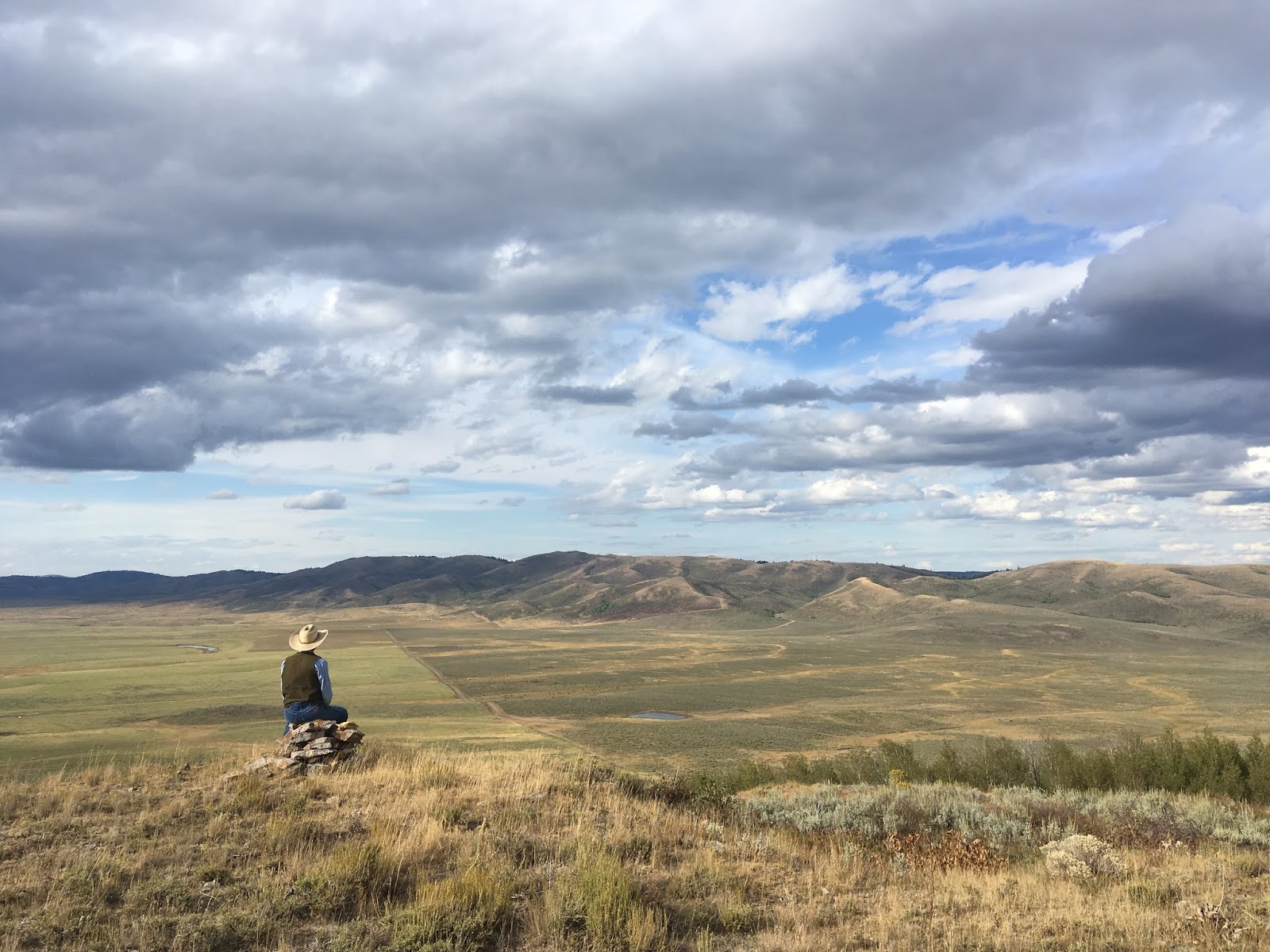
resting on a cairn most likely built by a sheepherder


Saturday, September 7, 2019

Signs of September

The hot weather finally broke. We’ve had rain all morning and a cool breeze. It feels lovely and it's so good for the range.

My garden is finally bearing. Oh, how we love fresh vegetables. Mark says they taste like what they are. A cucumber tastes like a cucumber. Crisp-tender and so delicious!

If you read my stuff much, you know that weeds often intrude on my writing. This time of year it’s goatheads that, well, get our goat. We know there's other weeds knocking at our door as well, some worse than what we've got. Mark came in the other day and asked if I knew what the yellow-blossomed plant was growing down in the corner pasture. He grumbled about a new noxious invader to deal with. I checked it out and didn't recognize the plant either, so I took a photo and emailed it to our county weed supervisor. Imagine my surprise when the email was returned with these pleasant words: “the plant is a native wildflower important for pollinators.” I was so happy. I told Mark, after all our weed worries, that it was a good omen.

We had a big herd move in the mountains. We had to go through the neighbor's cows in an adjacent pasture and over a mountain. There were creeks to ford and gates to thread the herd through. We had plenty of riders and the move went well except for the wind. The range was dry and several hundred hooves kick up a lot of dust. We were coated with dirt by the end of the day. I had put on sunscreen and chapstick which only attracted the dirt and turned my features black. Mark studied me, then handed me his handkerchief to wipe my face. I told him I was fine, I wasn’t far from water, but he insisted. “It’s awful,” he said.

Mark and I stayed overnight to clean up any pairs that got separated and came back to find each other. We heard bawling in the night and knew they were walking back individually and hopefully finding one another in the dark. After a leisurely breakfast the next morning and a 4-wheeler ride to check grass in the fields behind us, we had 12 pairs and one calf to take back. The air was still and it was a nice ride. I asked Mark if I could come next year for clean-up day only. “No,” he said, clean-up day is the reward for helping with the move.

It's a grasshopper year and one of the worst we've seen in the mountains. We witnessed a strange phenomenon when we came upon an especially heavy area and decided they were mating en masse. They were in clumps of one female and one or more males. The males are small and yellow, the females larger and brown. Their eggs will lay in the ground and hatch next year. Not something we welcome, but with the bad is always the good. About a week later, I was changing water at home and saw two monarch butterflies in a mating embrace. Another omen!

photo by Anita
it  only got windier as the day progressed 


yellow bee plant


everyone should grow a vegetable or two

lots of milkweed but no caterpillars


Wednesday, August 28, 2019

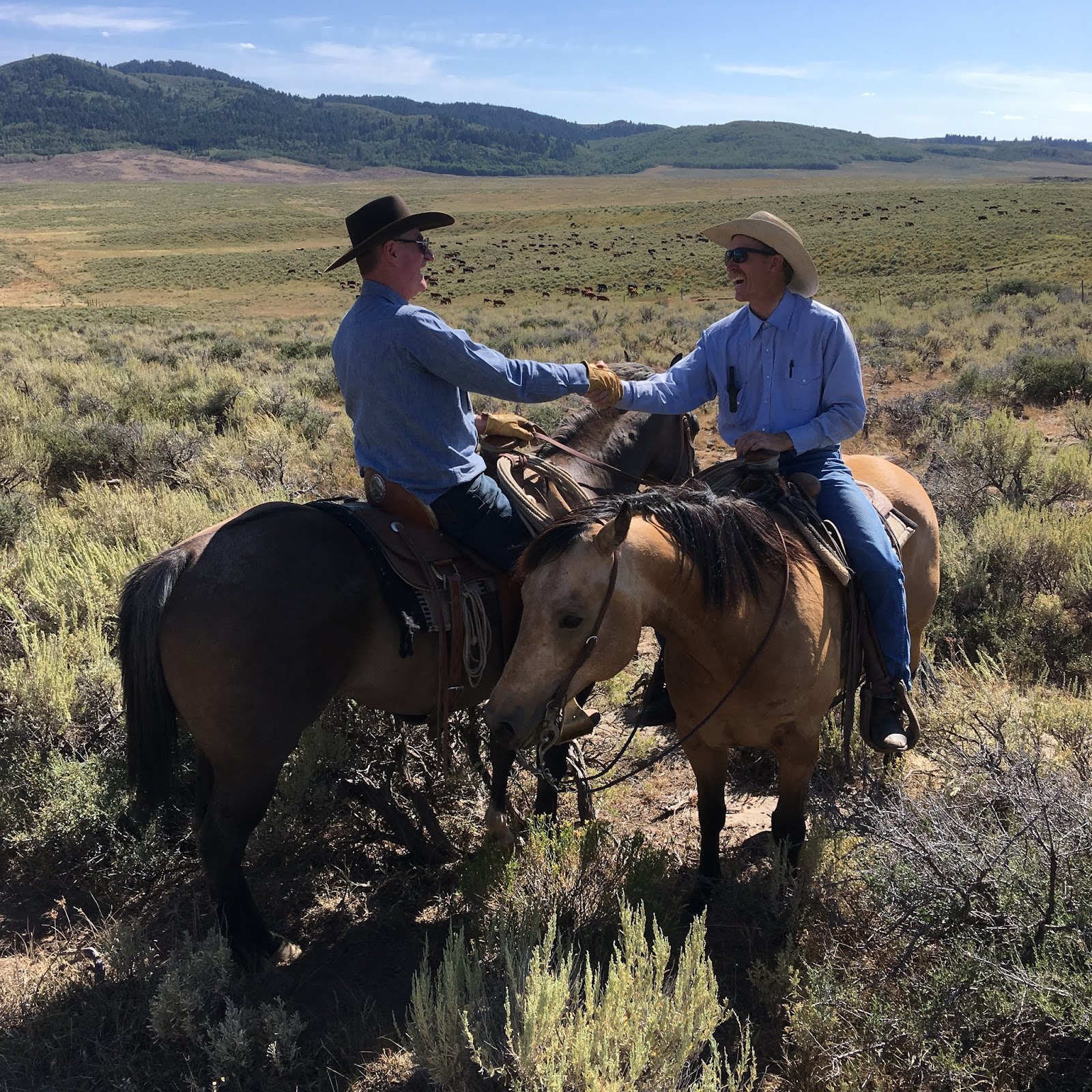
An Eight-Thousand Mile Handshake

Ben was a long ways from home, but in his element. He was visiting the Western U.S. from his home in the Falkland Islands, and came to spend a day on an Idaho cattle ranch. Mark saddled Gary's solid horse, Joker, and though Ben hadn’t been on a horse in years (he uses a quad, 4-wheeler, at home) after about 15 minutes he settled in and became just another member of our crew. The day’s task was moving the herd of cows and calves onto fresh grass in an adjoining pasture, while separating the bulls as they went through the gate.

Ben raises sheep and cattle in East Falkland and deals with similar issues as ours: keeping electric fences hot, overgrazing/overresting of plants, stock density, grazing timing, invasive plants, erosion, isolation, effects of weather, and the list goes on. When he arrived at our home and we settled on the deck to visit, we wasted zero time with pleasantries and went right to the heart of the challenges and opportunities of raising livestock on the planet today.

He stayed the night with us and said he woke up at 2 a.m. and wrote an email to himself, and to us, with, “the answer,” he called it. The email talked about the hurdles we face in applying the powerful tool of grazing to the best of our abilities, and how we need to “get it right in our inner world, in order to get it right in our outer world.” We know exactly what he means. Like us, he has one foot in traditional methods and one foot in the new/old world of holistic grazing. There are many blocks to advancing our best practices, some real and some we just think are real.

Ben is the same age as Mark and this was his first visit to the States. After a few hours of gathering cattle under a gorgeous Idaho sky, the heady scent of sage all around us, he said if he had come as a young man he might never have gone home. I rather doubt that after hearing the deep love in his voice when describing his homeland.

He showed us photos of beautifully restored grasslands after addressing decades of overgrazing by sheep. One photo showed a sea lion lounging amongst giant tussock grass plants along the shoreline - with cattle in the background! Turns out that grazing, if done at the right time of year and then allowing the plants to regrow, can complement the use of the same habitat by sea lions. Other seashore users are penguins, who prepare a kind of seedbed with their nesting activity. Ben and a group of volunteers then follow up by planting plugs of tussock grass thereby restoring a healthy coastline.   

We were surprised to see that the cattle grazing Ben's land were of the same hereford based breeding as ours. One photo showed a group of yearlings walking off a barge onto Ben’s farm, and they could have been our own.    

We are joined with Ben by an ethic, a philosophy, a love of land and animals. We’re joined by a thirst to find better ways to enhance soil fertility, grass vigor and ecosystem diversity, while improving the carbon cycle and ultimately helping to address climate change. The path is rocky. Ben and I have both read the timely book, Call of the Reed Warbler, by Charles Massy, and I found a line that I wish I had shared with Ben. Massy quotes Wes Jackson who founded The Land Institute in Kansas. "If you’re working on a problem you can solve in your own lifetime, you’re not thinking big enough.” The words resonate with us and I'm sure they would for our new visitor as well. Ben, if you're out there, let me know what you think. 


Thursday, August 15, 2019

Dot makes the Grade, and other News


We've been moving cattle around like usual. Here at home the heifers have been seesawing through irrigated pastures. We blood tested the group of possible replacement heifers for pregnancy, and then armed with the results, gave each one a new identification tag to join the breeding herd. We appreciate the new processing chute even more each time we use it. It's quiet, safe and functional. A good design always makes such a difference. 

The other heifers will head to a final feeding phase before being turned into nutritious food.  The flow of energy from the sun, to plants, to animals, will be completed as nature intended. But as Seth told me, "Mom, it's  not by some grand design or intention. It's what worked!" What he means is that ruminants cycling cellulose created from the sun's energy - while moving frequently - worked throughout evolutionary time to provide for multitudes of species. Many folks, especially the fake meat crowd, are blind to this simple process. 

I've been having fun with my young border collie, Dot. She's really pulling her weight now after a slow start. She excels at fording streams and canals to gather cattle on the other side. She's gaining confidence and following my cues to stay where she's needed. She's finally learning to move off a steady stare and to commence "herding," which is after all her job. I'm no expert trainer. We just stumble along and somehow get the cattle where we want them, learning as we go. Sure is fun with a helper. 

Mark and I spent a night in the mountains to fix fence and move cattle. After fencing for several hours, we quit early - well 7:00 pm or so - and tried out our new solar shower before fixing supper. It was great, even though we added hot water to please Mark for his turn. The next morning I woke up with a sick headache and still had to get on Jane and ride for several hours moving cattle. I had forgotten my meds, but hoped if I ignored it, my headache would go away. And it seemed to do just that while in the midst of herding a bunch of cows that didn't know where they were going. But when we finished and had to ride the hour back to the cabin, I was miserable. 

Summer moves quickly at high elevation. The wrens are already gone from around the cabin. They had a nest at the outhouse and scolded us continuously on our last trip. It's getting quiet too soon for me. 

The other summertime constant at home, besides moving cattle, is moving water. Mark heads to the ditches every morning. He keeps a plastic tub in the bed of his pickup to collect trash that shows up in the waterways. It's easy to understand how garbage ends up in the  ocean because water intercepts objects which then make their way downstream. Most of it is single-use plastic drink containers. What an unnecessary crutch we're teaching our kids to expect. And even if you don't throw it on the roadside, it ends up somewhere. We can do better. 


early morning gather


the power of a good design


tools of the trade


what the canals (and Mark) gather up