Friday, September 23, 2016

Grazing and Fire Behavior

previously published as commentary in the Post Register, September 21, 2016

We summer cattle in the mountains of Southeastern Idaho, and last week after checking the herd, we took the long way home through Bone and toured the area of the Henry’s Creek Fire. Ouch! The devastation along Willow Creek is hard to grasp. This once dense thicket of willows looks like a bombing range.

Fire is from time-to-time a natural occurrence, and there will undoubtedly be some beneficial effects of this fire as time goes on, but it will hardly offset the costs of fire-fighting to the taxpayer (in the millions) and the cost to wildlife through short term habitat destruction, never mind the cost in private property damage. Worse yet is the nagging fear that this fire will be followed by more to come if drier, hotter summers become the norm. The desert west of us is where they have to worry about devastating range fires . . . right? 

We drove to a vantage point where you can see where the Tex Creek Wildlife Management Area abuts private ground. It’s easy to observe the fence line contrast between the total annihilation of plant life caused by dense fuel loads (years of ungrazed grass) on the wildlife management side, and the much reduced effects of the fire as it entered a landscape that had been grazed and consequently had less fuel. Is this difference significant to the recovery process?   

The Wildlife Management Area, originally acquired as mitigation for the Ririe and Teton dams, encompasses some 34,000 acres. It provides vital winter habitat for 8,000 – 10,000 elk, deer and moose. We’ve yet to hear what percentage of the area burned, but we know it was significant.   

This wildlife refuge, combined with Conservation Reserve Program lands in the vicinity, meant plenty of ground in the path of the fire was “set aside” from grazing. Did this have an impact on fire behavior? Is it time to consider adding domestic grazers to the management scheme of the Wildlife Management Area?

I’d like those two questions to quietly sit in the minds of wildlife managers - without any opinion attached to them for the time being.

And remember, grazing isn’t grazing isn’t grazing. Perhaps a light spring graze would leave plenty of forage for the elk, and in fact freshen it a bit for better palatability when the wild herds return. But I’m not advocating grazing as much as I’m advocating a conversation that includes grazing as an alternative.  

I’m reminded of a commencement address I listened to this spring given by James Ryan, dean of the Graduate School of Education at Harvard University. He talked of the need for “inquiry over advocacy,” of asking “wait, what?” when confronted with the curiosities of life. He said we’re too quick to race to the answer instead of searching for the right question in the first place, or if the right question is found, exploring the nuances held in the answer(s).  

Ryan urged his students to “see past the easy answers and to focus instead on the difficult, the tricky, the mysterious, the awkward, and sometimes the painful.”

As devastating as the Henry’s Creek Fire appears, it presents a unique opportunity to contemplate questions that local ranchers, recreationists, and wildlife lovers should not let go unanswered.


Tex Creek Wildlife Management Area on the left, private ground on the right
photo by Becky Davis


Wednesday, September 14, 2016

The Birds and the Bees

It’s remarkable how quickly the dog days of August morph into the cool of September. We had rain this morning and the subtle colors of fall are made richer by dampness.

Have you noticed how quiet September is? The migrating songbirds have left for warmer climes and the year-round residents are silent since the mating, nesting, fledging season is past. If you listen closely, though, the call of the meadowlark is still with us. A harbinger of spring, my Dad said they start singing again in the fall. And my Dad knew everything!

We sat on the terrace last night and watched a group of nighthawks circling to the west as the sun went down. For a few weeks we heard nighthawks every evening but never saw them. Now here they were in full view but with only the occasional shrill cry.  

The cattle are grazing golden cured-off grasses in the mountains. To me this grass is every bit as beautiful as the greens of springtime. We’ve had a few sick calves and Mark has been monitoring the herd regularly. If he finds a sick one, he ropes it around the hind legs and when the rope is pulled tight, if he doesn’t have another roper with him, he dismounts and has his helper, usually me or Anna, get on his horse and hold the rope while he gives them a shot of antibiotic and two large sulfa pills (the tag number recorded to follow a different marketing channel later). With just that much help - a life is saved. Cattle can get virulently sick in a hurry, but recovery is usually ensured if they’re doctored soon enough.

Here at home, Mark took a day off from the ranch to make steps off the back of the house with railroad ties. They descend through my xeriscaping project, which is coming along nicely albeit at a snail’s pace. I’ve transplanted native plants from surrounding habitats - sagebrush, rabbitbrush, indian rice grass, baby cedar trees and blue flax, but my laissez faire attitude, thinking it could be low-maintenance, is a little skewed. Just because the plants grow wild on their own doesn’t mean they’re easy to establish in a yard. I collected wild seeds of buckwheat, horsebrush and lupine from the ranch yesterday in hopes I can get them started as well.  

A happy surprise has been the transplanted rabbitbrush, which has lovely gray foliage in the summer and is now covered in golden blossoms. In the wild it establishes on dry, disturbed sites easily, so it’s just what I need on my desert sand that I’m too stingy to water. This shrub’s late flowering, which happens as other blooms fade, arrives just in time to provide valuable food for bees and butterflies. Bees need pollen to over-winter and they’re making good use of the many plants that grow on our ranch.

Rabbitbrush is humble and undervalued. It’s not sexy like sagebrush. But like many nondescript, background sustainers and supporters, has its niche and its own beauty. 


Wednesday, August 31, 2016

Before Summer's Gone

It’s still hot, hot, but there’s a fall feel to the breeze that moves through the windows at sunrise. It’s quiet since Anna left for North Idaho for her first real full-time job. I’m not comfortable with life’s passages and late August is ripe with passages.   

Callie made the move from New York City and is now safely ensconced in a perfect apartment in Boise. She’s getting her feet under her and finding lots of support in her new community. This Mom is very happy to have her back within shouting distance.

The girls were in full nesting mode as they prepared to leave for their new apartments. Anna did some DIY projects, using lumber she found around the ranch, leftover paint and canning jars from the store room. Callie rounded up some warped boards from the burn pile that she hoped to turn into swooping, hanging shelves. They needed Mark’s help and he took an afternoon off from ranch work to do just that. He and Callie had to make a few trips to Home Depot to get the shelves hung. He laughed, saying what she really wanted was for them to levitate in her living room! 
               
Mark and I served as grand marshals of the Little Buckaroo Rodeo Parade. Seth said, “that’s for 70 year olds!” Mark has announced the rodeo for 25 years so comes by it honestly. We rode in the parade in Gary’s horse drawn surrey pulled by two white steeds named April and May. Anna and great grandma Bonnie sat in the back seat. What fun! The surrey even had fringe around the top, so of course I had to sing the song from Oklahoma!

Anna and I froze corn and canned peaches before she left. To that we added red potatoes, beets, kale and basil from the garden as a starter kit for her kitchen. She takes her roots - figuratively and literally - with her. 

It’s a bittersweet time of year. Always has been. Mothers put their youngsters on the school bus for the first time with an aching heart. Little kids move into the fourth grade hallway or across town to the middle school with high hopes. Big kids go off to college. It’s transition time. 


photo by Katie Wallace


Now we hope they seal


Tada!

Saturday, July 30, 2016

Dirty Jobs

July is about used up. It’s hot. We don’t have air-conditioning, but the house stays cool if we open the windows at night and close them up tight by 7:00 or 8:00 in the morning. It’s one of the best parts of living in Idaho – cool nights.

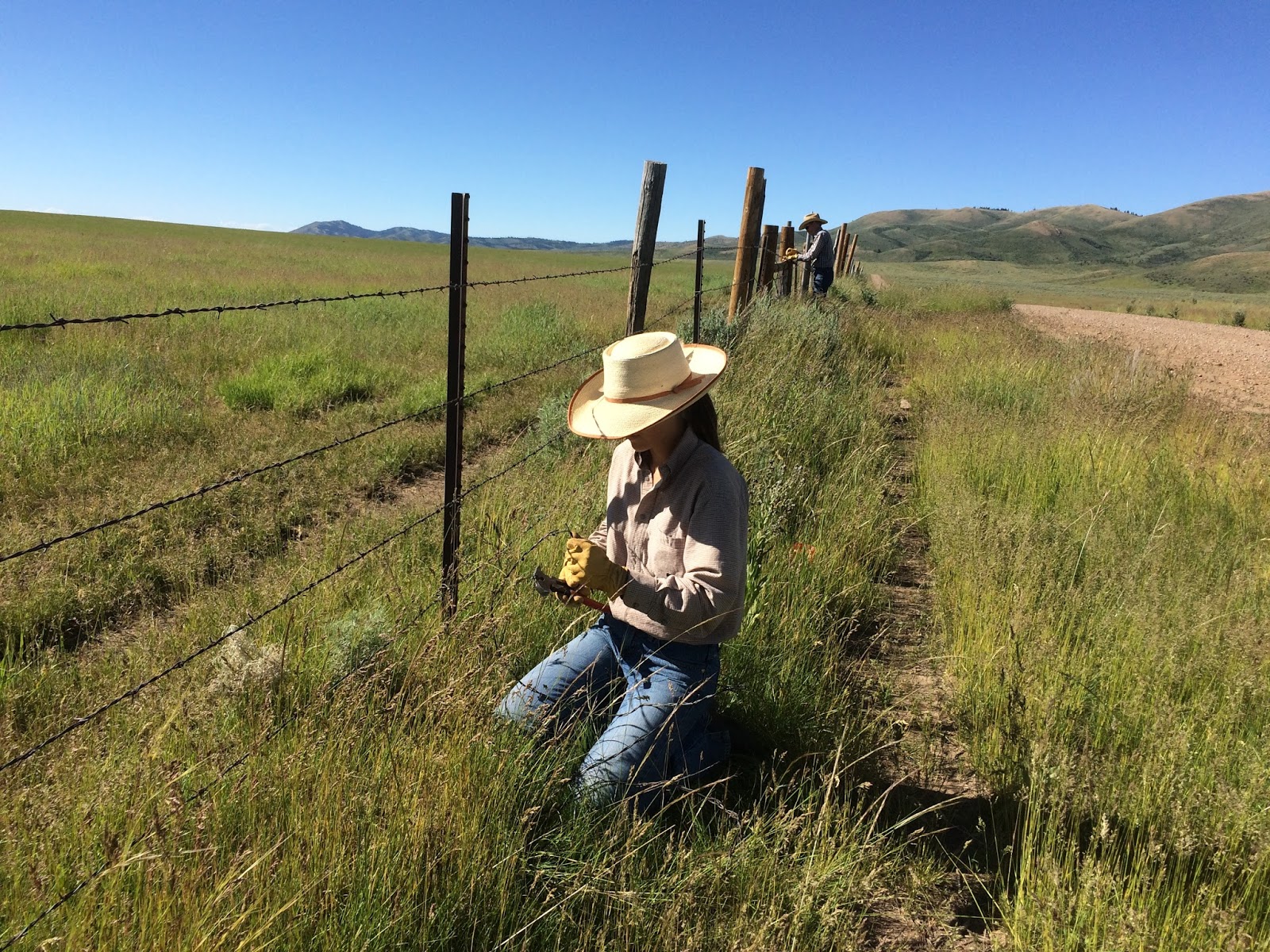
Mark has been fencing in the hills, which is a never ending job if you’re a rancher. We acquired property 4 years ago whose interior and exterior fence lines are totally electric. It’s been a constant chore getting them to stay charged. The voltage is erratic and it takes multiple chargers being moved from one section of the fence to another throughout the season as the herd moved from one field to the next. Mark and Colton came home from an extended stay in the mountains and said they finally got 5,000 volts in the whole thing with one charger!

It’s weed fighting season. Weeds make me think of my great Aunt Elsie’s line, “there’s always something to take the joy out of living.” Our land is diverse: dry sandhills intermingled with irrigated pastures, canals, and timbered areas. It’s great for wildlife, but unhandy to keep weeds out of. We’re judicious with herbicides, preferring to manage weeds with cultural methods, but find ourselves spraying to have a chance against their onslaught. I discovered a different kind of thistle while changing water one day. It was huge – as wide as my outstretched arms and taller than me, with stout, leathery leaves. I hacked at the stem with my shovel and it made a cracking sound as it fell to the ground. Ack! I felt like I was in some horror movie where weeds appear overnight and gobble up the children.

Mark tried something different with the heifers. We took the bulls out after 40 days with plans to draw blood from each animal and have it tested to detect pregnancy proteins. This allows for a tighter birthing window and opens up marketing options for the heifers that didn’t “settle” within the breeding period. Our crew included Callie, Anna, and my sister Becky, a retired vet technician, who drew the blood. Beck brought her grandkids  who hung out in the heat with us alternately tracking wild kittens in the barn and helping sort blood vials.

After I put the last three head in the chute, I took the kids down the lane to Great Grandma Bonnie’s for Fresca and donut holes. It’s the best part of ranching, working with family. And unlike much of largescale agriculture today, ranching is still hands-on and family friendly. You have to be intentional about it, though. Callie and Anna, kids once themselves who learned the ropes underfoot the working adults, knew to keep the little kids busy with “jobs” of their own.

Callie, especially, as a kid, wasn’t happy if she had “none jobs.” We laugh about the time when she was 5 years old and helping Gary with some ranch project. When Grandpa Eldro arrived, she said he could go home because, as she put it, “Gary already has help!” For children, this learning to do and seeing the results of one’s efforts, is critical parenting, and so beneficial as to deserve a line of its own on the profit section of the ranch’s income statement.  


So mad to find houndstongue here!


working heifers
Clancy and Clara have jobs

Sunday, July 17, 2016

Citizen Science

It’s mid-July and we've had some pleasant, coolish days. To make it even better, the mosquitoes and flies are taking a bit of a hiatus. Wait, what?

We’re heading into the crunch season of irrigation and our streams are already losing their springtime exuberance. The late afternoon wilt can be seen across the hay fields waiting for water.
 
I’m having fun in my garden. We have beets galore and a variety of greens. I’m planning on surprising Mark tonight with creamed new potatoes and peas!

I’ve had two “citizen scientist” escapades lately. It's apparently an old (ala' Ben Franklin), now new movement to empower the public in natural resource management based not on regulatory actions but on education and volunteerism. 

First I attended a workshop by Tim Ekins, University of Idaho Extension Water Educator, to learn how to monitor parameters of stream health including dissolved oxygen level, velocity and turbidity (cloudiness from suspended particles), pH, temperature, and bank characteristics. The best part was using a screen to collect organisms that live on the bottom of the stream. We sorted through debris with tweezers and transferred any bugs to an ice cube tray for identification. Seth’s fly fishing talk of caddis and stoneflies came alive to me during this exercise. So that's what he was talking about!

The second science lesson was hosting Peter Donovan of the Soil Carbon Coalition who returned to the ranch to revisit a carbon plot on one of our pastures. Peter educates as he monitors. At one point he pulled out two loupes, small 5X magnifying glasses that fit in your eye socket, and invited me and Colton, a young man working on the ranch this summer, to lie down in the grass and observe the soil surface. Worm castings rose up like boulders and giant ants scuttled around the grass stems. Later we looked at seed heads and tiny bugs on flowers with the loupes. It blows your mind and makes you know how little we grasp of the natural world.  

We ranchers and farmers need to try harder to mix it up with the scientific community. I’ve learned both parties can be skeptical of the other. We cowboys can be intimidated by the scientist’s unfamiliar names of our common plants and their sometimes superior attitude. Likewise, I'm guessing biologists are suspicious of the cowboy culture and don't think they can relate to us. Truth is, a richness comes to the conversation when both disciplines are included. And in my opinion our resource issues will only be successfully addressed when the two “sides” come together.   

Resource management aside, the citizen scientist in me is a perfect fit with the artist in me. Knowing their contribution to the ecosystem only makes the species that live here on the ranch more beautiful.  

They're not endangered around here


fighting over who gets to collect bottom dwelling macroinvertebrates!


Peter eyeing soil life with a loupe


the loveliest grass of all, Indian Rice 

 mules ear and quakies

Monday, June 20, 2016

A Toast to Grass

Summer is in full swing, which means most evenings we eat outside. Tonight we’ll watch and wait for the June full moon, the strawberry moon, which just happens to fall on the summer solstice, a rare occurrence. Mark and I talked about the northernmost sunrise this morning and how the sun will now head back south along the rim of the mountains until its about-face in mid December.   

The garden is up and hitting its stride. The peas will be blooming soon. I've stymied the cabbage moths by putting mesh around the cabbage plants and thinned the kale, a new/old favorite I planted for the first time this spring.

We’ve been enjoying bird traffic around the house, bobbing goldfinches, regal cedar waxwings in pairs, and the occasional flash of an oriole. We don’t cotton to bird feeders, but provide currants, serviceberries and chokecherry bushes for au naturel dining.  

Anna is spending the summer with us, weighing fall employment options and taking some much needed downtime to reflect on her college career and dive into ranch work. She’s been Mark’s right-hand cowboy all spring. We lost her horse, Mater, last fall so she’s been riding 21-year-old Birdie, who’s as light and lively and high-strung as ever. Birdie and I don’t exactly mesh, but easygoing Anna is getting along well with her.

The cattle walked their way to the high country and are happily settled in a sea of grass. Oh, how Mark and I love grass. So much so that at a restaurant for dinner yesterday, on the terrace on a perfect evening, we raised our glasses; "to grass!” I said.

It was written eloquently about grass in the late 1800’s: “Grass is the forgiveness of nature, her constant benediction.” I’ve memorized the words from the 1948 Yearbook of Agriculture, a large green tome entitled, Grass, which Mark’s grandpa gave me 25 years ago. An essay by Kansas senator, John James Ingalls, extols the “enduring blessings” of grass which captures my love for this, a most inconspicuous but essential family of plants. Grass moderates soil temperatures, diminishes floods and droughts, feeds life in the soil, sinks carbon, and through the gut of an herbivore, provides nutrients to the food chain long past its short green season. 

It is this last function, the joining of cow and grass, that is the principle job of a rancher and that which we take most joy in. 


Anna on Birdie

Kate working the flank

it was a long walk


Saturday, May 21, 2016

A New York Minute

We’ve been moving cows to grass. May is rushing by. But I’m not ready to leave April until I write about my trip to see Callie in New York City.  Words and photos, this is how I deal with the passage of time and events, and my children turning into adults. I’ve never understood how other mothers can stand it if they’re not doing the same thing.  

I don’t know if Callie even knows what a “New York Minute” is, but she can probably guess. The expression attempts to describe the fast pace of the city. Johnny Carson explained it once as that instant between when the light turns green in Manhattan and the car behind you honks the horn.

It was the first time for me flying and traveling such a distance alone. Callie’s sweet face greeted me at LaGuardia and we shared an indulgent late night taxi ride back to her apartment. Just grabbing a taxi from the line in front of the airport was an adventure. The rest of the trip was the same, me tagging along as she lived her life. We strolled through the cherry trees in full bloom at the Brooklyn Botanic Garden and dodged Sunday morning traffic on our bikes to brunch and back. We experienced the quiet awe of the 9-11 memorial and hoofed it though the east side and the west village. It was a treat to watch Callie at two dance rehearsals and see her in her element, cussing and discussing artistic expression.

Callie’s Crown Heights community of Brooklyn is predominantly West Indian/African-American and Orthodox Jews. It was a bit unsettling the first time we visited, but by now I feel at ease walking the streets.

Callie commutes everywhere by subway. She does it by rote, glancing at her phone from time to time checking routes as the stations whiz by. I enjoyed following her lead, free to observe the other travelers who avoid eye contact with you. One night a large black man with a beautiful booming bass voice was playing guitar on the platform. A middle aged white woman with boots and a long skirt got off a train and when she heard him, broke into song, harmonizing for a single verse and one chorus, and then stepping back on the train with a big smile. The guitarist, who had been looking down, raised his head and grinned as the wind hit us from the departing train. All in a New York minute. 

Callie dances with a company that performs outdoors, often in public spaces where the “public” might be in the midst of the performers. The venue is very much an element of the art.

The diversity of the city was evident at one rehearsal in particular in Battery Park on New York Harbor. Juxtaposed against the dancers were the local Hasidic Jews out celebrating Passover. The Jewish men were clad in black cloaks and hats and side curls, the women in wigs and modest skirts. They have large families and many young mothers were pushing a baby stroller. The tourists were there as well speaking unintelligible languages, as were the ubiquitous joggers, huffing and puffing and weaving their way through the strolling masses. They all watched Callie and the other performers with interest, but not surprise, as it was just another day in this city of contrasts.     

The highlight of my trip was the evening performance by her dance company, Kinesis Project, as part of their annual fundraising gala. We guests watched from an overhead balcony as the dancers performed on a perfect harbor evening with the Statue of Liberty in the background.

Sometimes when I lie in bed at night, I think of my daughter and imagine myself above the U.S. landscape whizzing across the countryside following a meandering route eastwardly to the Atlantic Coast. I picture the Rocky Mountains, the plains, the cities and farm ground, the Mississippi River, the homesteads and traffic, until I arrive at her Brooklyn brownstone. It is a surreal feeling and is comforting and unsettling at the same time.

She went to New York for the opportunities of the dance world. She didn’t realize it would instead be a coming of age, a reckoning with herself, and more difficult than she could have imagined. She now has the city and its challenges firmly under her belt and is ready to slow down, get back to nature and closer to home, but she’s having a hard time leaving her friends and artistic community. She repeatedly sets a departure date and then moves it back. She seems a little more determined this summer to make the move and I’m keeping my fingers crossed, but in the end I just want her to be happy. 


rehearsal
  

the performance
 photo by Stephen Delas Heras

the fabulous cherry trees at the Brooklyn Botanic Garden