Thursday, August 6, 2015

July Photo Opp

The weather continues to be unsettled - thundershowers, hail, or like today, sunny, muggy and warm. We’ve had nothing as hot as the first week of July. And of course these lovely Idaho nights are cool and comfortable.

We’ve been focused on Mark for the last week since he got bucked off Jane in the mountains. She touched a hot wire with her nose and went ballistic. Mark couldn’t get a good hold on the reins and scared her further by being in and out of the saddle while she jumped. A concussion and one (maybe two) broken wrists later he is healing little by little. Our hired boys only have a few more days with us so Mark's getting all the good out of them he can.

Before Mark’s wreck we had a quiet day hosting a photographer from our marketing cooperative, Country Natural Beef. Lynn Howlett, http://www.lynnphoto.com, showed up one afternoon while Mark was cutting hay. Not thinking swathing was much of a photo subject, I sent him over anyway, only to have him get some great shots of Mark holding a baby meadowlark that had flown out of the hay. Mark picked up the youngster and tucked him in a windrow a few rows away and under cover from the circling hawks. His mother was chirping nearby.

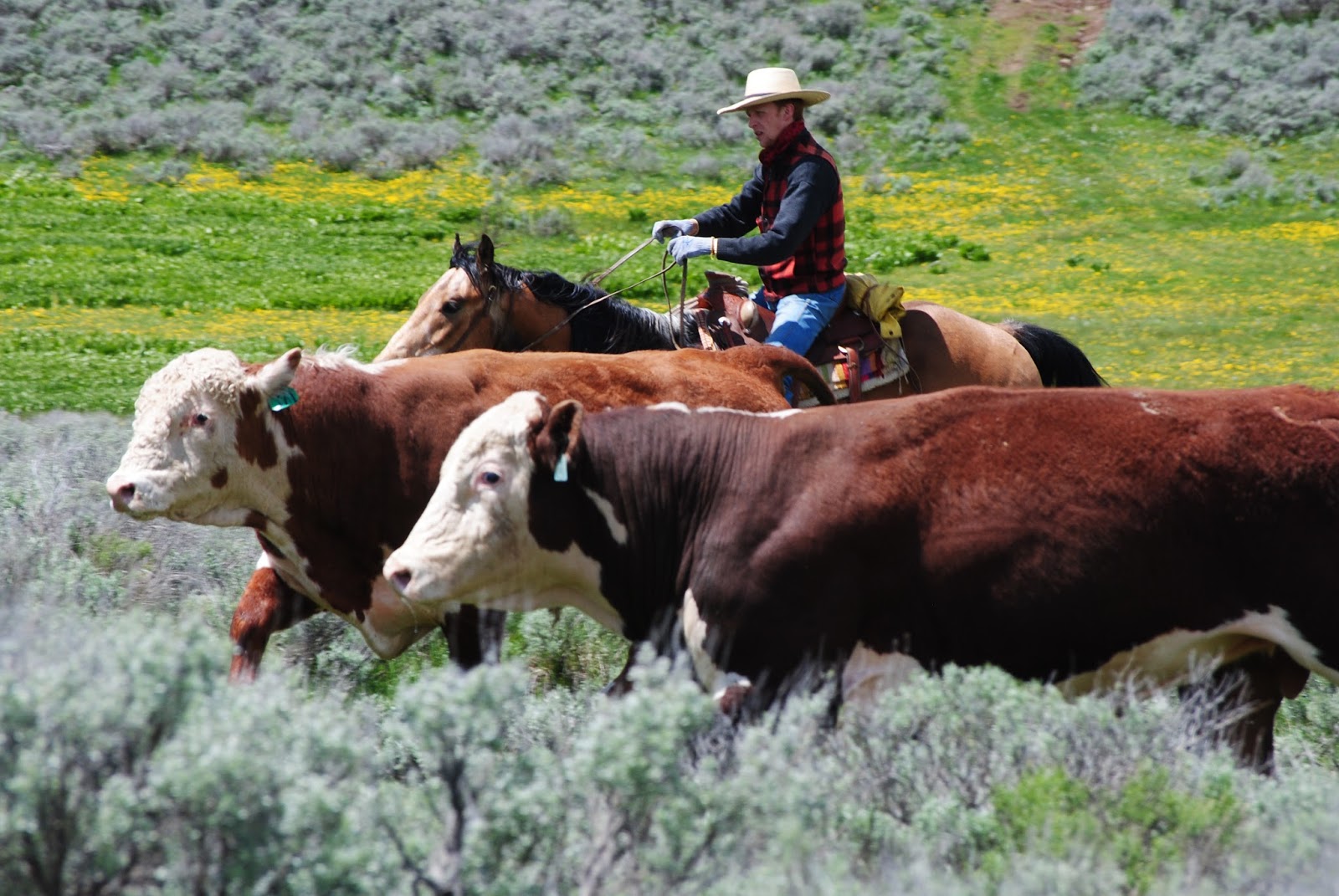
Then the next morning Lynn accompanied us to move the replacement heifers to a new paddock. We stopped at grandma Bonny’s on the way to get a generation skipping photo. She’s a good sport, even though at 96, not exactly excited to pose for a photograph. 

What we ended up with was a typical ranch day's smattering of images. Cattle and horses, grass, a little wildlife and some simple folk that live on the land. Images made memorable by the hands of a professional. I wasn't so sure to begin with though.  

Mark has taught me (is teaching me still) that good enough is good enough. His favorite line is “things are seldom ideal.” Might as well get on with it. And that’s how it was with the photo shoot. I would have preferred the kids were home as they make such beautiful, youthful figures on horseback. I would have preferred to travel to our range ground to get some spectacular scenery as a backdrop. Of course I would have preferred looking twenty years younger too, but that didn’t happen either. Still, the photos are fun, and in 10 years when the faces of family and our animal helpers have changed, they will be priceless.   

When we finished, I grabbed Lynn’s camera and did a turn-around on him. He called it “a gift” because he’s always on the other side of the lens.  


Monday, July 27, 2015

Four-of-a-Kind

Labor is always an issue on a ranch. Our ranch seems especially so since we do a lot of labor-intensive flood irrigating, put up our own hay and run back and forth from our valley operation to tend cows on our summer pasture in the mountains some 45 miles away.

We’ve had a string of hired help. Some good ones that move on to more lucrative positions. Some poor ones that the only thing we gained was an education by hiring them. Some steal from us. Some are sure they’ll love the ranching life and don’t last the summer. Some we hate to see leave.  
One thing we know for sure, there’s lots to be learned from working on a place like ours. Gary says they should pay us for the first six months.

We’re trying an experiment this year. We’ve toyed with the idea of having summer interns, young people that Mark could use his teaching skills on. Mark was a high school agriculture teacher in his other life and excelled at influencing young people. It’s his forte and I’ve always felt badly that he had to choose between that noble occupation and running a ranch.

So with that idea in mind, Seth had a friend in his fraternity that was interested in working here. Word spread and by spring that number had grown to four. They’re not really interns, they get a regular paycheck, but it’s giving us an idea of what an internship project would look like

Hand picked as they were, it was wonderful knowing their character before they set foot on the ranch. Still, it’s been challenging for Mark finding work for them to do every day. And yes, they’re green. You can’t exactly point them at a task and go about your other work. Training has been ongoing, but how reassuring it is to know we have their strong backs and willing attitudes to lean on these few months. 

They like to show up in the evening when Mark and I are sitting outside on our terrace after supper. Like most kids they stay up late, and visiting with Mark about the day’s adventures and what they’re doing tomorrow is a favorite activity. They laugh and sometimes I have to close the bedroom window against their voices and go to bed.

They’re staying in a little rental house where we spent the first 10 years of our marriage. The house is nearing the end of its useful life – having one last fling before a date with a bulldozer.

Summer is waning and soon they'll be gone. Back to school, back to bigger things. We hope they take a little of the ranch with them. Maybe they'll rise a little earlier, work a little harder and be a little sharper in their observation skills at their next job because of their practice here.

They can set a dam in a ditch and not have it blow out. They can haul a load of hay without dumping the bales. They can split wood, identify weeds, handle a horse, install irrigation headgates, set up and move electric fence, build a brace, and they have a good start on reading cattle.

But our best gauge of the success of the summer was given to us by a conversation our neighbor had with Gary. We lease pasture from Leon and Bonnie. They're retired and enjoy walking their property and sitting on the deck during the summer. The boys have become acquainted with Leon and like visiting with him from time to time as they cut weeds and walk the ditches moving water.

Leon said to Gary, “Mark is a good teacher.”

“Oh, why’s that?” asked Gary.

“Well, he strides right out when he irrigates. I always know it’s Mark from a distance just by the way he walks. When the boys first started they walked pretty slow. Now when I see someone out irrigating, I have to look twice to tell if it’s Mark or one of the boys!”

Austin, Morgan, Drew and Daniel

Wednesday, July 22, 2015

Fresh Bulls

The rain we had in May means a spectacular grass crop in the mountains. Gary says in his 60 plus years of ranching he’s never seen anything like it. We spent two days this week in the hills and I’d like to spend every day there, soaking in the abundance of it, stowing it in my memory bank for dry years to come.

It was time to change out some bulls. The cows come into heat and are receptive to breeding all at the same time which requires a healthy bull battery. Seems pursuing the females is hard work, and from time to time we give a few haggard bulls a respite in the valley before going back at it. We had five fresh bulls to put out and five to bring in, three that would take a final ride to the local auction and two that needed a rest. Mark hauled the bulls and I brought the horses along in another outfit.

We dumped the bulls out, had lunch and rode through the herd to gather up Mark’s picks to come home. Loading animals in a stock trailer usually means walking them to a corral or at least backing against a fence to encourage them to walk inside. That said, we’ve had fun figuring out how to save time by loading cattle out in the open.

Mark knew from experience that the first bull we tried would be a challenge. The bull is what we call “high headed,” wary and ready to move away quickly. He has a large flight zone, that bubble of distance around an animal which they would prefer we not penetrate. We had to trail him across the valley, so we took the opportunity to reassure him that we would respect his flight zone and release pressure if he moved in the direction we wanted him to go. You can’t “shove” an animal on the way to the trailer and then expect it to load when you get there. The same principle applies to handling people if you think about it.

When we got to the open trailer door, the bull made a couple of laps around it, then stopped and looked in – and we stopped and waited. He is typical for our ranch, weighing close to a ton and can move quickly and do exactly as he wants if prompted. He thought about the interior space for a couple of minutes and then stepped calmly inside. Once the first bull got in, the pump was primed and the next four loaded easily.

Mark and I have had our battles working cattle together. There’s a variety of methods that work, and often we’re at odds about how to tackle a particular job - but not today. We worked together just like we’d been at it for 25 years. And this November it will be just that.


a gorgeous grass year

after scratching in the sagebrush, he calls to the herd

not exactly eager to be back with the ladies

one captured, four to go

Monday, July 13, 2015

Eastward Ho

Anna had time off from her job with the National FFA Organization for the week leading up to the fourth of July, so we decided to make a family trip out of it. Callie took the bus from New York City and Seth flew in from Charleston, South Carolina, and we all rendezvoused in Washington DC. Yes, it was a “pinch me” experience for this mom.

We took a road trip that started in Maryland at my sister’s home on a tributary of the Chesapeake Bay. Every time I visit I notice the cross-stitched sign on her wall, “East or West, Home is Best.” We kayaked on West River, swam in Donna’s pool and watched for fireflies flashing in her yard. She has a majestic magnolia tree in bloom and I marveled at its milky-white waxy flowers. Magnolias and fireflies – how many romantic lines have been written about these two species?

Next we traveled to Brooklyn (with me driving - what!) and stayed in Callie’s apartment. It was warm enough for Mark to compare us to rotisseried chickens by morning. The next day we toured the nation’s largest rooftop commercial garden, BK Grange. They turn a profit every year and benefit the city by providing “green space” which helps slow run-off during heavy rains.

From there we drove to upstate New York which lived up to its storied reputation, rolling emerald hills dotted with historic red and white barns and well-kept homesteads. Our destination was Foxfield Farm, the dairy and home of the Quick family where Seth spent time during his year as a national FFA officer. We watched the Quick brothers milk one morning. Now fiftyish, they’ve worked and milked together since their youth. There is a rhythmic beauty to the twice daily ritual, the swish-swish of milk pumping into the bulk tank, the cows at feed waiting their turn at the milker, the hands of the human caretakers moving from cow to cow. Milking starts at 4:00 a.m. and is repeated each afternoon.

Their family farm is like ours in that we’ve raised good kids with solid values that come from living on the land and caring for animals. Ironically, those values are coveted in the outside world and our kids have a plethora of career options to explore. Can the farm compete for their future? Both of our sons look to return home someday, but how will our businesses change as we transition to the next generation?

We ended our trip in DC on the fourth of July. We started with a patriotic concert at the National Cathedral, squished through the rain following a short visit to the Library of Congress, and finished up with a picnic on the steps of the Jefferson Memorial to await the fireworks on the Potomac. There were twelve of us in our party and we won’t soon forget Leah, Seth’s girlfriend, leading us in the Star Spangled Banner.

Looking back to our first day of the trip, before we got our travel legs under us, we were walking through the airport (was it Houston?) and I said to Mark, “it’s hard to leave home.” He wholeheartedly agreed. It’s hard to get ready to leave and it’s hard to feel comfortable once you’re gone, but traveling is a gift you give yourself. The gift of insight and appreciation for this vast and varied world of ours.


Pure Brooklyn   
 

BK Grange rooftop garden 

beautiful upstate New York

happy cows 

the barn has been around awhile

heading back out to pasture after milking

waiting for fireworks on the steps of Jefferson Memorial

Thursday, June 25, 2015

Moonwalking

We should all be more comfortable with questions and not so quick to spout our opinions. After all, we know less than we think we do, especially about the biological world. That’s one thing Jack and I share, the joy of questioning. We both like a question that hangs comfortably in the air, causing contemplation, not the rush to an answer.

So it was no surprise that we found more questions than answers when we walked the wilderness area encompassed by the Craters of the Moon National Monument during the height of the preserve’s famous wildflower season. The staff here had told Jack that a sage grouse breeding lek existed on the property. We wanted to see what the habitat looked like.   

Eruptions occurred here over some 13,000 years, the most recent being only 2,000 years ago. It was not from a single volcano erupting in the classic sense, but rather lava that flowed up and out of a deep fissure known as the Great Rift. The area was designated as a national monument in 1924 when explorers pushed to have the lava flows protected. Then in 1970 much of the land was deemed wilderness, a rarity within the National Park System. In 2000 the area was expanded and now encompasses 750,000 acres, some of it privately owned.     

We toured what the Hawaiian’s call a Kipuka, an island of natural vegetation surrounded by lava, thereby eliminating most human effects, including wheeled traffic, grazing, etc. We both wanted to see what this non-grazed area looked like. 

Jack and I sparred over the health of the grass community. I was convinced that the (what I call over-rested) plants would benefit from periodic grazing, as long as they received adequate recovery periods. He wouldn’t go for it, insisting that I was making assumptions based on limited knowledge. “Maybe that plant is just old,” he said.

We walked all the way to Little Prairie which had burned in 1992. The vegetation here was noticeably different, more grass, less brush. Our wet May meant an impressive sea of waving seedheads. But what about plant spacing? Could well managed grazing help fill in the bare ground?

Much of our walking followed the hint of a trail recently traversed by an elk. We noticed here and there her preference for penstemon blooms!   

In our nine mile journey we walked across lots of different degrees of what we might call “healthy” range. Some areas were abundant and diverse, others mostly bare ground. And the one thing that Jack and I agreed on, these differences were NOT caused by cows, or sheep, or any domestic grazing animal. They were caused by soil composition, aspect, etc. And in our culture’s heated debate over the effects of grazing, that’s a mouthful. 

a grouse was here, I even flushed a hen and three chicks!

in the distance, the 2000 fire which left behind a sea of cheat grass

the translucent blue of penstemon
lovely in anyone's eye

with no grazing, there is nothing to remove old growth and rejuvenate the plant
Do you agree?

cheat grass established with no domestic grazers

this area burned in 1992, lovely tall grass from a wet May
Could there be less bare ground with good grazing management?

bed of delicate monkeyflower 

no fire, no grazing by domestic livestock
Is it healthy? And as compared to what?


Friday, June 12, 2015

Making Memories

Spring has turned to summer. Seed heads are showing on the hay ground which means it’s time to break out the harvesting equipment.

This May’s accumulation of rain has been a Godsend for the cattleman. The plant life is unusually prolific. The cottonwood trees that surround our home have showered us in big clumps of cotton for over two weeks, the heaviest I’ve witnessed in my 25 years on the ranch. 

Spring’s last hurrah was one more big move with the cattle, which included hosting guests who had purchased a “rancher for a day” experience at the Leadership Idaho Agriculture Program year-end auction.

It would be a long day. We had to gather the Meadow Creek pasture, go over two bluffs and make the long climb to the Smyler Canyon divide, then down on into Paradise Lane. Mark figured it would take about 6 hours for the actual move – that is if things went right.  

The first time we tried it we had to turn around and come home when the roads got too slimy from heavy rains. It was fine with our guests, Jeff and Debbie Williams, because that meant they could bring their son John back with them in a couple of days when the forecast looked better.  

Our second try turned out to be a spectacular herding day. We had perfect temperatures - in shirt sleeves with a stiff breeze to keep the mosquitoes away. The sky was studded with fluffy clouds. The range was a soppy deep green, the sage wet and fragrant. And all along the way were these lovely little rain ponds for the cattle and dogs to drink from. Sly and Mater took good care of the visitors and Debbie would later call it “an experience of a lifetime.”    

A side benefit was a dutch oven meal waiting for us at our destination prepared by our friends Dick and Lonna Jean Conroy. We don’t often mix pleasure with trailing cows, as there are lots of unknowns - and spoiling the meal by being late was not an option! Luckily the cattle trailed nicely and we made it, a little late but not too late. The meal and company were superb, but as the evening progressed we couldn't help but notice storm clouds building in the west.

You know that heavy, deathly still air that precedes a storm? It happened as we were visiting following dessert. We just looked at each other and then sprang into action, cleaning up dishes and ovens, loading horses, gathering up folding chairs. At one point we took the ends of the rain spattered plastic tablecloth and simply folded it over the remaining goods and piled it in the Conroy’s trailer. When we were all loaded, I gave one last hug to Dick and Lonna Jean as they scrambled into their pickup. My hair looked like Lonna’s, wet dreadlocks, but we were laughing and loving the adventure of it. One for the recordbooks!

picture perfect

Debbie and John on the divide

What a spread!

I think we're in trouble, look at that sky!

Dick and Lonna Jean, "salt of the earth" folks
photo by Debbie Williams

Monday, June 1, 2015

Perfect, perhaps

Mark and I are catching our breath after moving cattle here and there for the last couple of weeks. We’ve had lots of rain and our world is a verdant paradise. After a mild winter and dry March, the moisture came out of nowhere and just keeps coming.

We laid in bed for a few luxurious minutes this morning. It was warm enough to leave the window open all night for the first time this spring and a cacophony of birdsong woke us. Mark called their clamoring, “the excitement of a new day.”

We had one perfect day in the mountains with the kids before they left for the summer. We took up a load of bulls to deliver to the cows and calves (seems we intend to do this all over again next year). Then we had to move the herd across a creek and into an adjoining field.    

I say the day was perfect, but that’s not entirely true. Seth got annoyed with me when I parked my 4-wheeler right directly in the path of the bulls so I could get a photo from the right position. An artist has to get her shot! Then Anna was perturbed when I had a different idea of how to get some straggler calves to cross the creek. Somehow my long experience with cattle herding (while they gallivant around the countryside) carries little weight in my kids’ minds!

Then Seth proceeded to tell me we didn’t do enough to protect the stream banks for fish habitat. “Easy to say when you’re not here to make it happen!”

Annoyed with them, I left to put out salt while they watched the herd settle in. When I returned, still in my not-so-pleasant mindset, I found them in good spirits singing cowboy songs! Another lesson for me. A brief moment of annoyance is just that - a moment - not a habit. Let it go.

And the photos were worth it, don’t you think?