Sunday, March 18, 2018

Anna takes a Break

Anna is working on a graduate degree in agricultural education and has been home this week on spring break. She’s an enthusiastic ranch helper, so it’s been great having her here for such a busy time on the ranch.

Each morning we walk to headquarters to tend the barn. Today we emptied three stalls, one with a set of twins, one pair with a calf that had been grafted on to another mother, and the third, a neophyte heifer that needed some help delivering her baby. It’s fun to see the calves haltingly follow their moms out into the big wide world.

The mother of the twins kept them both nearby, turning and humming to the one on the left, then turning and humming to the one on the right. The graft mother who had delivered a dead calf a day ago was thrilled with her new charge. The calf, a twin, had been sucking surrogate moms for a few days and was content to finally have a full belly.

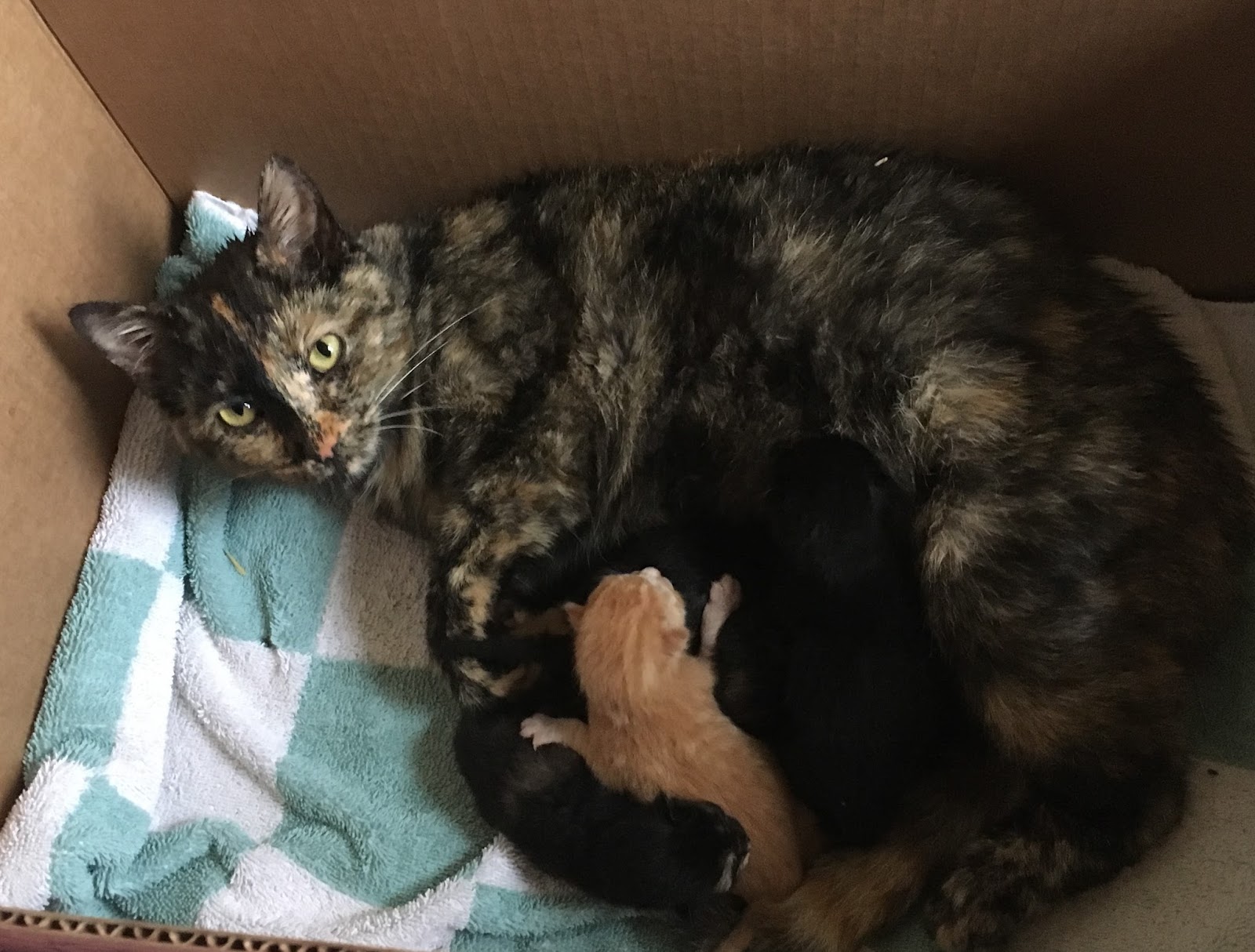
This afternoon Anna helped Seth with newborns from another species – a batch of kittens! We had examined the mama cat, Roxy, a few days ago and held our hands around her belly and felt the kittens move. We knew their arrival was imminent. Sure enough she had them under an old fuel tank the next day. She moved them once before we got them collected and put on Seth’s porch for safe-watching. Another neophyte, this little gal had six kittens.  

Besides calving it’s also shipping time for the first batch of last year’s calves. Anna and Mark sorted and weighed steers yesterday and then loaded them on a truck bound for Oregon for finishing. As one set of calves leaves the ranch, the next generation hits the ground.

As we were working together on her last day here, and the dread of going back to school stalked her, Anna talked about the particular predicament of a rancher’s daughter. Yes, the sons have the burden of deciding whether to take on the mantle of ownership to the next generation. And for some of them, when outside opportunities call, it’s a difficult decision. But what about the daughters? They love the home place too and want a future there. But if she expects to find a partner and raise her own family and doesn’t see herself as taking over for her father, where does that leave her?

I get it. As one of six daughters raised on a family ranch who all hoped they could find a similar life, I feel her pain. Some of us ended up on ranches, some did not. It’s just complicated and there aren’t easy answers.   

All I can tell her is that the ranch isn’t going anywhere. We’ll work to make room for our kids, male or female, and in whatever configuration that might be. Part-time or full time, just visiting or with homes on the ranch, the barn door is always open.   


cleaning stalls while the twin calf goes for a run


following mom


shipping steers


Roxy and her brood

Tuesday, March 13, 2018

Cover Crops make a Comeback

Previously published as commentary in the Post Register on March 8, 2018

There’s a groundswell rising up in the world of agriculture, and Southeastern Idaho is ripe for the new “technology.” It’s actually an old practice that’s come back around in new ways – cover crops, defined as those grown for the protection and enrichment of the soil. And it’s not just farmers who will benefit, but everyone who’s concerned with soil health and making the best use of our precious water resources. In other words, all of us. 

I’ve been reading Dirt, The Erosion of Civilizations, by David R. Montgomery, which chronicles the demise of societies throughout history due to a loss of soil fertility. It’s a disturbing treatise knowing that we rely on fertilizer which is a finite resource and considering the direct link between healthy soil, full of organic material, and the capacity of the earth to capture and hold moisture. Droughts and floods happen naturally, but their severity is directly tied to how well the ground holds water.     

Besides capturing water, cover crops anchor soil. Wind erosion in our area is a serious problem. We consider it a natural consequence of wind on exposed, bare soil. But must the ground be bare? For our ranch, sand drifting in to our fence lines and irrigation ditches means constant maintenance. What if road closures due to blowing dirt were a thing of the past? Some events you can see and feel with your own eyes. But for the most part erosion is a silent marauder. Montgomery’s line “It seems that the slower the emergency, the less motivated we are to do anything about it” is haunting.       

My husband’s grandfather planted cover crops in our sandy soil, which he would then plow under to enhance soil fertility. This was a good start, but now we know to use no-till methods so as not to disturb the millions of microorganisms that live in the soil providing a web of life so critical to soil health. We know to leave plant litter on the soil to act as armor, and to leave living roots in the soil for as many days as possible throughout the year. To jump start the process, we’re relearning the old practice of using grazing animals to cycle plants and return 85% - 95% of the nutrients back to the soil through manure and urine. The savviest cover-crop farmers also know to sow a seed mix of different species, grasses and grains, root crops and leafy crops, etc. each with a specific attribute for increasing soil enrichment.

This winter, Soil Conservation Districts throughout Southern Idaho have hosted workshops to learn more about cover crops and no-till. These events are eagerly attended by young farmers ready to look at soil with fresh perspectives. The Natural Resources Conservation Service has funding help and good information to share. It’s not a quick fix for sure, but long term, regenerative actions rarely are.

It will take foresight, new knowledge and willing growers, but the future is bright for innovative farmers to make a positive difference in our community.  


We visited a neighbor's beautiful cover crop on Halloween 2017 - ready for grazing

Thursday, March 8, 2018

Mothering

We’re getting calves and old man winter is having his way with us. Ranchers who calve their herds in January and February are feeling mighty smug this year because the weather was so warm and dry in mid-winter. But now? Try several inches of snow and an icy wind to blow it into drifts.

It was an “all hands on deck” morning today. Luckily Seth was available on a Sunday and Jesse is vested enough to work on his day off. We got the cold ones brought in and suckled at first light. Then we fed the herd and now I’m sitting in luxury, typing, while the sun shines on this beautiful white stuff and the guys are out making the rounds again.

Thank goodness for Jesse. He’s been with us for over ten years and has become a real hand in the barn. He’s patient with the cows and goes about his tasks with a methodical manner that calms the mothers. It’s a quality that only those of us with long years of experience handling large animals can truly appreciate.

Both Seth and I tried to milk out a cow with what Mark calls anvil teats. When milking such a cow he likes to say, “whoever said a cow ‘gives’ milk has never tried it.” No matter how we tried, we couldn’t get anything to flow. Enter Jesse with his big strong hands and easy manner and soon there was a pitcher full of colostrum, the first milk that a baby calf or a baby human needs to consume within a few hours of birth to thrive.

It’s familiar, this annual ritual of calving. I’m not like some ranch wives, however, who say this is their favorite time of year. Mark works too hard and I’m getting less willing to go out in the cold to help him. I do like to tend the barn though. Cleaning stalls and helping the babies in the quietude of the space is pleasant.

We’ve been watching the PBS series, Call the Midwife, this winter. It’s so wonderful and poignant as it details the birth process and the various situations babies are born into. The agony of those who lose a child or can’t conceive. The ecstasy of holding a newborn with no thought of the pain it brought and the immediate love that flows to this new being.

We don’t celebrate and honor mothering as we should anymore, but a rancher never forgets. It’s all about the mothers in our business. A cow that jumps up after calving, licks her newborn, coaxing, standing to allow nursing, ever watchful, is a miracle and a wonder. 


tending her first calf and doing a beautiful job


Friday, February 23, 2018

Grandma's Camp Trailer

It’s late February and we’re having the most bitterly cold morning we’ve had all winter.

We brought the two groups of cows closer to ranch headquarters for calving. So far the babies are tucked safely inside their mommas and we hope they stay that way until this cold snap passes.

I’m still on a ranch cleaning jag. Yesterday I emptied Grandma Bonnie’s camp trailer. Gary rescued a few keepsakes - the box of assorted card games, a cast iron griddle, and a warm sheepskin collared coat. The remaining supplies will find new homes via the local thrift store. Now we just need to pump up the tires that are melting into the sod and get it to the local solid waste facility.

Of all the old items we’ve sent down the road, this one is the most difficult. For all the memories . . . I almost said that will go with it, but they won’t of course. We have the memories tucked away in our heads and hearts.

The 45 mile trip “up the trail” to deliver cattle to our mountain range ground is an annual spring pilgrimage. Grandpa Eldro insisted on camping overnight with the herd and Bonnie, his most trusted helpmate, was the camp jack that made it happen. A circa 1972 Kit Companion trailer fit the bill. Bonnie shopped until she found a trailer with the perfect floor plan with lots of space to tend a big cowboy crew. She could set everyone down at mealtime and when evening came, the tables collapsed and the chair cushions doubled as mattresses so everyone had a place to sleep. There was even a fold-up top bunk for the kids.

Mark remembers Grandma firing up the propane range for early morning coffee. The fumes would travel across the ceiling to his bunkbed, and as his asthma symptoms kicked in he knew it was time to get up.   

Supplies for six days of meals meant a shopping spree that Mark got in on as a kid. The owners at Carl and Don's Market knew Bonnie by name. She stocked up on Shasta pop by the case, including Mark's favorite, cream soda. She baked pies, cookies and cakes and stuffed the trailer house full of staples. On top of feeding the cattle herding crew, she fed friends and neighbors who happened along tending their own cattle or taking a leisurely drive to the mountains. She served hearty “from scratch” meals on real plates with real silverware. 

She pulled the trailer with a 1975 Ford 1-ton with a stock rack holding extra water in an old pressure tank, bales of hay for the horses and additional camp supplies. She was a familiar sight on the road, shushing cattle with her dishtowel in tight spots, picking up trash and negotiating steep mountain grades with courage beyond her small stature.

I had just started dating Mark when I rode along for a day of herding cattle along Brush Creek. I hadn’t officially met the family when dinner time came around and I bashfully headed to the trailer to eat. I took off my chaps and washed my hands at a basin Bonnie had set up outdoors. We went inside for a delicious meal of roast beef with potatoes and gravy and green beans, with chocolate cake for dessert. What a welcome!

Things change of course and Anita and I do it differently. With the utmost admiration for Bonnie’s method, we prefer to pack a cold lunch, which when paired with a hot thermos of coffee and homemade cookies, feeds a cowboy crew just fine. No, it’s not the same as Bonnie did it, but it will do.

What really matters is a kid in the saddle on a gentle horse, well-fed cowboys and cowgirls looking out for each other, a smile and a wave to passing motorists, and cows with calves at their sides at the end of the day. And besides, if we were driving the truck and cooking who would work our dogs?

(at the very last minute Gary suggested posting the trailer on Craig's List free stuff. It was spoken for in less than 5 minutes of posting by a guy wanting storage space!)

Eldro, Bonnie and Mark


A familiar sight along the Trail  

Friday, February 9, 2018

Grandpa's Steel Pile

It’s been a mild winter. Before the calves start coming, we’re taking advantage of the lack of snow and ice by cleaning up around ranch headquarters. This land has been in Pratt hands since 1904. That’s a long time to accumulate stuff or what Gary would call “treasures.”

I agree with the treasure part. I’m as sentimental as anyone about past generations and the way things used to be done. I love running upon an old piece of farm equipment that was pulled by draft horses, parked once during a busy time, never meaning to be left out in the sagebrush, and now a gentle reminder of how grandpa did it. But time stands still for no one and the present and future trump the past every time. Mark said he could feel the yard “free up” as we cleaned.

There was a pile of steel odds and ends behind grandpa’s garage. Every farm needs one. It was slowly being buried by sand and leaves from the elms and box elders that line the yard. We sorted most of it to take to the scrap dealer, tossing the keepers another direction. Angle iron over six inches long, steel plate over a foot square, solid steel tubing, etc. will be stored in a central location for repairs or the odd job that needs a piece of scrap. The other goes to town.

Mark put the sides on our old 1977 Ford truck and took a couple of loads into the metal recyclers. He got a nice check and found out we’d need the money to pay the county to recycle our used tire collection!

We thought more than once as we worked about the burden of ownership when operating a farm that’s been around for a hundred years. If our place were ever sold, the old stuff would be pushed in a pile and hauled away or burned. For us, each item is handled and carefully considered. We don’t take this lightly.  

During an open winter like this one, Mark’s grandpa would have been scraping sand with a Ford 5000 tractor, enlarging the irrigable land between the sandhills for planting crops. The 5000 replaced the tiny 8N Ford which back then looked pretty big compared to a team of horses. Winter also meant Eldro and a younger Gary would be repairing farm equipment for summer-time work. They did what they had to. They made do. Repair, reuse, recycle wasn’t a catch phrase for them. It was life.

Things have changed. We don’t farm much anymore and we hire most of our large equipment work done by others. Farm machinery has gotten too big and expensive for a small operation to own anymore. The custom hire operators specialize, and when they arrive they make quick work of what grandpa would have taken a month to achieve.  

We may clean up behind them, but our forebears are not forgotten. We appreciate the same view of the mountains out the front door. We tend our livestock with the same careful eye. The winds that blew our sand in from the Snake River many eons ago still blow. They still rattle the house at night when sleep won’t come and thoughts of the future roll around in our heads.   


Tuesday, January 23, 2018

Back to School

We’re on vacation. Well, not really. The weather is so mild it just feels like a vacation. Last year during January we were chaining up to feed in the morning and pushing snow most afternoons. The bales on the outside of the stack were frozen and had to be chopped apart by hand. This year the sun is out and the days are beautiful. Too beautiful if your summer depends on snowpack in the mountains, but we’ll worry about that in due time.   

A rancher deserves to hibernate for a few weeks in the dead of winter. It’s nice to get a break when the grass isn’t growing; the weeds aren’t rushing to set seed. No sprinkling the lawn. The garden is asleep. The canals are empty and the calves are nestled snugly inside the cows.

It’s the time of year when a rancher goes to school. We’ve been attending a few gatherings to sharpen our skills in range management and cattle handling, and we’ll meet with our beef marketing cooperative, Country Natural Beef, next week in the big city of Portland.

Today we attended a dog clinic taught by Jack Knox, originally from Scotland, and now living in Butler, Missouri. He taught his first clinic on the ranch when Seth was only 3 years old so his methods have influenced the way we handle dogs for over 20 years. Jack still speaks with a heavy Scot brogue and admonishes us, “let your dog work!” He says we're too busy trying to control our dogs. “Don’t look for what she does right, look for what she needs help with and help her. This is how you build trust in a dog.”

Jack is a master stockman. His voice, brogue or not, connects with the dogs immediately and they respond to him one by one throughout the two day clinic as we owner-handlers struggle to understand and emulate. I try, but sometimes the connection he has with the dogs is so deep, so enigmatic, I just sit back in wonder.

Jack emphasizes the livestock, which is great to hear if your livelihood comes from cows. Yes, the training is all about the dogs, but livestock are the reason. Keeping stock calm, using position rather than “bite” to guide them where we want them to go is the goal. Lots of people train to win dog trial competitions instead of training dogs to work livestock calmly. Jack says we can all be winners if we apply his principles.

According to Jack, the typical rancher gets about 30% out of his or her dog’s potential. What could we do with the other 70%? It’s fun to think about and with six ranch dogs in the clinic, we’ll have a fresh start at it in the spring. 


Leah with Dot doling out hay


Seth and Jack with Elsa and Dot


Learning to ride hay bales and building confidence


Wednesday, January 3, 2018

A Year at a Time

And so the New Year begins.

We’re feeding cows every morning and finding a kind of reassurance in it. We know how to do this. Spread the bales out so everyone gets their share, include lots of straw for energy when it’s cold, break the ice on the troughs so the cows get a good drink, then reload for morning. 

The New Year always brings up reflections of where we stand, where we’ve been and where we’re going. It’s time to take a breath and reevaluate our lives. Big questions like estate planning and how to provide for a multigenerational family business always come up this time of year.

Family businesses can be the most difficult to navigate. Is it really a business if you gather up the kids who’ve come home for the holidays and feed cows on Christmas morning?

I composed a set of questions to give to all the members of our family ranch. Easy questions – well most of them were easy. I meant them for personal reflection, but to hopefully share with our spouses or with other family members if we choose. What gives me joy as I go about my daily life? What did my parents do that I want to emulate? What role do I play on the ranch today and what are my fears regarding my role here in the future?

The last question was the tough one. Tough for all three generations. For each person or couple, much of the answer depends on what the other two generations decide. We’re intertwined in many ways so unraveling it is a challenge.

My hope is that whatever we do, we do with clear intention. I trust the intent of each one of us, and to be diligent in our actions to meet that intent is all we can really offer to one another. And that’s enough.


The cows are in two bunches, older and younger


the ranch in holiday dressing


lots of New Years since this was used


a practically perfect Christmas morning