Friday, August 1, 2014

Growing Supper

We've had cooler weather. It's still hot during the day, but the breeze coming across our bed at night is chilly. My front flower bed is in full bloom, mostly black-eyed susans which are lovely, but the scattered purple coneflowers are what the hummingbirds and butterflies visit when they show up. 

It’s that time of year when everyone growing a garden feels pretty smug with themselves. They bypass the produce section in the grocery store and learn anew how resplendent, colorful, varied in taste and texture a vegetable really is.

I thinned the beets and served the young tubers along with the greens on top, root and all. The taste is pure mother earth. You don’t think of beets as sweet, but they seem so when contrasted with the hint of bitter in the greens, a delicious pairing.

And the new red spuds are perfection. “Like butter,” my sis would say about them, as she does anything that is as good as butter is.

I tried the Ruth Stout method of planting spuds. Not with the entire crop, just the ones I intended to harvest as the season progressed, as opposed to those I want to leave in the ground for fall harvest to be stored over the winter. You lay the cut spud on top of the ground with an eye or two on top, then cover it with a heavy layer of mulch. A sprout develops and comes up through the mulch and grows a large plant while under the mulch a feeler comes out to start a new potato. You can reach under the mulch and see the whole process, harvest what you want, and then pull the mulch back over without disturbing the little ones. My grandmother, who liked to sneak a few spuds out mid-season, called this careful harvest “tickling” for potatoes.

There are lots of yards around but few vegetable gardens. I don't understand why anyone with a patch of earth, owned or rented or borrowed, wouldn’t put in a seed and grow some food. I think if we all nurtured a cucumber or squash, a few plants of basil or beans, many of our planet’s problems would abate - just from the knowledge gained by grasping the power of dirt. We’re all dependent on it; we’re just romanced by supermarkets and restaurants, fooled into thinking we don’t owe our lives each day to soil and water and sunshine.


yes, it's all edible


Thursday, July 17, 2014

Teaching Teachers

Mark and I have been gorging on green peas from the garden. He likes them lightly boiled, add butter. I like them straight from the pod, preferably one after another as you’re picking them. Didn’t we all do that as kids? Raid the pea patch? If you didn't you should have. One of the joys of childhood . . . and adulthood.

I am officially connected. Yes, I got an i-phone. I was having a hard time talking myself into it. My sister-in-law, Mona, told me, “Of course you’re worth it!” Seth told me, “Go ahead and get it Mom. You’re going to have buyer’s remorse, but that’s okay.” It's a kick. I can even send photos with my texts to the kids!

It’s been hot, in the mid 90’s most days. We lucked out and got a break in the heat long enough to host an evening function at Gary’s dance barn; twenty-five teachers touring Idaho agricultural operations for continuing education credit. They were hosted by a program called “Ag in the Classroom.” What fun, engaging, inquisitive folks they were!

Mark showed them an irrigated pasture and explained the benefits of time-controlled grazing. I compiled a slide show of a year on the ranch. Then as supper was laid out in the shaded courtyard, Mark walked them out for a “meet and greet” with Gary’s Longhorn pairs. The evening was perfect, no wind, no bugs, sublime temperatures, good food and stimulating conversation.

It was the culmination of the teachers’ three day tour and they shared insights they had gained from visiting food producers including, among others, a dairy, a large scale farm, a fish hatchery, and a honey bee operation. One teacher said, “I’m glad they (farmers and ranchers) are still here. My grandparent’s farm is a subdivision.” Another said that from her vantage in our state's capital city of Boise where promising jobs are offered mostly by hi-tech, the medical field and government, it had been a real eye-opener. “I can’t wait to get back and tell my gifted and talented students about the wonderful opportunities for a career in agriculture.”

Education – only this time going upstream to the teacher. We were honored to be a part of it. 


Saturday, July 5, 2014

Pedaling thru July

There is simple pleasure in having a bike waiting for you at the end of the sidewalk, slanted against the kickstand, waiting. I haven’t ridden a bike since, well, I never really rode a bike much. I got one in college, a ten-speed with skinny tires that I never felt safe on. Plus, biking in the city probably wasn’t in the cards for a timid country girl. I grew up on a dirt road, not much fun biking there either. Who knew at the age of fifty-four I would discover the joys of riding a bicycle?

Anna left her hand-me-down bike at home this summer. It's faded purple, a Diamondback, and just my size. Actually she forgot it, but now I tell her she can’t take it back until school starts.  

I live in the perfect situation for a bike. It’s a short ¾ mile to ranch headquarters, paved road, minimal traffic. I take the dogs with me, and my favorite part is stopping at the canal to let them wade in for a drink, cooling off up to their bellies. The plants are heady with July growth. On the way by I soak up a passing fragrance of . . . what is that? Milkweed in bloom, alfalfa, maybe yellow headed mustard, or just the coyote willows that crowd the lane. Today a swallow was tormenting a hawk, who just shrugged at her threats. Some days I pedal through a lovely bank of cool air. All of this we miss driving our vehicles with the radio on and the air conditioner blowing.  

Bonny, at 95, wishes she could ride with me. She told me about Gary’s bike he bought with his own money when he was 10 years old. He gathered beer and pop bottles for recycling. He would fill a case of twenty-four and get 35 cents for a case of beer bottles and 50 cents for pop bottles. He hit the mother lode in a neighbor’s trash heap, $11.00 in one stop! The local grocer gave him cash in return. His folks took him to Clegg's Second Hand Store where they sold new bicycles. When he got his bike home he was disappointed to find it didn't go very good in the sand. I discovered the same thing when I spun out in the stackyard.

Gary still has the bike, it cost $35.00, a fortune to a kid in the 50’s. He added a carrier later on to haul a passenger along. 

I'm on the hunt for a used basket to fasten to the handlebars and complete my look. 


Gary's blue and white Schwinn -circa 1954
(note the beaded buckskin gloves)

Tuesday, June 24, 2014

Shades of Gray

It’s been cool for mid-June. The hot weather garden plants have stalled out temporarily. 

We’ve had some rain, but not enough to give us much relief. A lightning storm blew through and spawned a fire in the lower elevation mountains along the Blackfoot River. I hate to see that, not that fire is necessarily bad. This one may have a positive effect, but I don’t want anything to encourage the march of cheat grass to the higher country. Parts of our nearby range is starting to burn regularly which encourages more of this annual grass to get a toehold. And with an extremely short green season, hence the name "cheat," it creates a tinder box of fuel. In southwest Idaho this combo has created a vicious cycle that threatens more and more native rangeland.  

We spent a few days in Central Oregon meeting with other ranchers throughout the West, taking a peek into each other’s businesses. We stayed at and toured a ranch where juniper trees are their major invasive problem. In their case, fire suppression is part of the scenario that creates a backlog of trees and the resulting simplification of the ecosystem. Seems every place has its nemesis. It was a beautiful operation with a respectful three-generation family that is addressing their challenges and making sure it works for everyone.

Mark and I went to check on the cows when we got home. We gambled on not needing a horse, so just took 4-wheelers to put out salt. What we found were a couple of very sick calves. Not to be deterred, Mark had me drive slowly alongside the calves while he sat sideways on the back of the machine with his lariat poised. At the right moment he hopped off and tossed the loop over the calf’s head and wrapped the rope around the rack of the 4-wheeler. I held the rope while he carefully gave them a shot of antibiotic and put two pills down their throat with a long handled “gun.” He said when there are sick calves there’s no need to be a cowboy. He's gotten really good at sneaking up on them. The procedure won't make the cover of a magazine but it works.

The older I get the more gray I see, not only in my hair but in all the situations of life. I know the answer to most questions is, "it depends." Whether it's grazing, fire, stockmanship - whatever, tell me how it's done, what other factors are at work, what's your objective? It's hardly black and white. 


a beautiful storm from this vantage

Thursday, June 12, 2014

June, Oh June

June is pure magic. I find lots to worry about, it’s just my nature - from world scale concerns like climate change and invasive species, to my own backyard landscaping which is progressing at a snail’s pace and what to fix for dinner. But every day there’s an underlying thrill, a great satisfaction, from simply living in Idaho on a ranch in June.

We moved a group of yearlings to the pasture in front of the house. We like to watch their grazing behavior over our morning coffee.

The replacement heifers are on a piece of rented property on the other side of town. Mark and I have regular dates changing paddocks. Yesterday following a move we bought a sandwich at the co-op and sat on the grass in the park for a picnic. That’s a rare occurrence.

I get regular updates from Seth who is interning at the Noble Foundation in Ardmore, Oklahoma. It’s tall grass prairie country, so he filled me in on the particular challenges producers face with too much, and not very nutritious grasses. One of the research projects he is working on is mob grazing. He was helping set up electric fence yesterday and dealing with cattle that weren’t trained to it. He said it felt like home!

I went with my friend Jack to visit the grazing/grouse research project being conducted nearby. We observed the technicians, Haley, from Portland, Oregon, and Jennifer, from San Diego, California, laying out a monitoring transect to measure vegetation traits of grouse nesting sites. This particular hen’s clutch had been predated. Her radio collar had sent a mortality signal, and we found feathers at the site so surmised she was wounded when the eggs were eaten. I enjoyed learning about the specifics of the project, but even more I enjoyed the conversations with Jack, a grouse biologist, and the stops along the drive to walk through and discuss what we see happening with vegetation on the landscape.

Yes, we’re behind, no we’ll probably never be “caught up.” When I get discouraged I think of a great line from Emily Dickinson, “to live is so startling, it leaves little time for anything else.” And I feel better just living. 

changing paddocks

changing paddocks, again

company for coffee

this hen picked poor habitat for a nest

Thursday, June 5, 2014

The Ranching Game

I spent a few days off the ranch and came home to an explosion of plant life. The orchard grass is waist high and all headed out. When did that happen? The annuals are already hardening off. Spring has barreled headfirst into summer.

The vegetable garden is starting to look lively. The peas and onions are up and the potatoes are just peeking through. I’m trying sweet yellow peppers and cabbage plants for a change.

Mark and I spent two days fencing in the mountains. We inherited an electric fence that needs lots of TLC. We tightened it after its winter rest and then tried to get it all charged. We each had a 4-wheeler and walkie-talkies and only got two-thirds of it hot.  

The hills are green upon green. The tiny white daisies, fleabane, are in bloom, as are bluebells and the loveliest of all, periwinkle camas. Part of the fence line goes up through the quakies. We followed a winding leaf-covered trail through the timber that looked like it had been landscaped just for us.

We stayed one night in the Meadow Creek cabin which was supposed to save us time, but with setbacks including a flat tire, we didn’t get home until dark. Now that the cattle are in the hills, it's a well beaten trail we travel back and forth. 

Sometimes it feels like Mark and I are trapped in the last of the old, struggling to transition to the new. We’ve complicated the ranch with more ground and more intensive management but can’t seem to get around it all. We embrace new technology only if it fits our philosophy of ranching. We like our old trucks and equipment, still irrigate largely with a shovel, and prefer pasture and “waste” ground to monoculture intensive farming. We would love to be totally pasture and range, but our valley ground is too valuable not to farm. Add dry conditions to the picture and it really gets complicated.

The fencing scenario in the mountains rings true for the whole ranch. Rusted barbed wire remains alongside new high-tensile wires for carrying electricity. Each time we tend the fence we have to carry supplies for fixing the old along with supplies for maintaining the new. Sometimes a stray barbed wire grabs a high tensile wire and shorts the whole line. I can’t help but see the analogy of that!

Navigating this vortex we find ourselves in is confounding. How do we balance the needs of the two older generations who live on the ranch with our own needs, and also look ahead to creating/maintaining a ranch that is viable for our kids and hopefully grandkids? It’s not for the weak of heart. 


old and new

Monday, May 26, 2014

To Grass

We made it to the range with the cows. Seth and Anna have been helping and Anita brought lunch every day. It’s an “all hands on deck” event.

We had two herds on the Trail at once. It took five days to go 30 miles with the baby calves, and four days with the older ones. Smaller bunches mean the cows and calves stay paired so they don't go back. If they can't find one another they'll return to where they last nursed. This trait is so strong that tending the back end of the herd requires much due diligence. Doing that job is Anna’s strong suit. She calls it quality assurance. Yes, the lead guys are important. They watch for obstacles up ahead like gates left open or stray animals and keep the lead cows from jogging away from the slower travelers. But don’t stick your most tenacious help up there; she (or he) is needed on the drag. Home grown help is irreplaceable. My prayer is that wherever the kids are in life’s adventuring, they make it home for the cattle drive.

Memorial Day festivities are in full swing on the range we share with the recreationists. We dumped the herd in the Brush Creek field which is adjacent to a popular camping area. As we pulled out on Friday evening, the campers pulled in.

The trail drive is the most love-hate event I can think of on the ranch. The first ride of the morning is sublime. Your horse is eager, the cattle walk out, the only sounds are sage sparrows and meadowlarks and the occasional beller as the cows pick up their calves. As the day wears on everyone gets more sluggish, water sources are scarce, it's dusty, and by mid-afternoon I’m sore and ready to call it a day.  

It's a mini life-lesson in five days: 

Be alert - well tended details create successful outcomes. Having to go back for a calf that was lost because of not paying attention is a make-work project.  

Be respectful – of vehicle traffic, of other people’s property as you “graze” by, and of your help-mate animals, the horses and dogs who give so much. 

Do your part – everyone has a role. If yours is guarding a gate, making lunch, saddling the horses, or riding flank, you play a vital role in the whole. 

And finally, get up early – cattle travel better in the coolness of early morning, you’ll get to your destination that much quicker. And as Gary will tell you, "people die in bed." 

Anna on drag

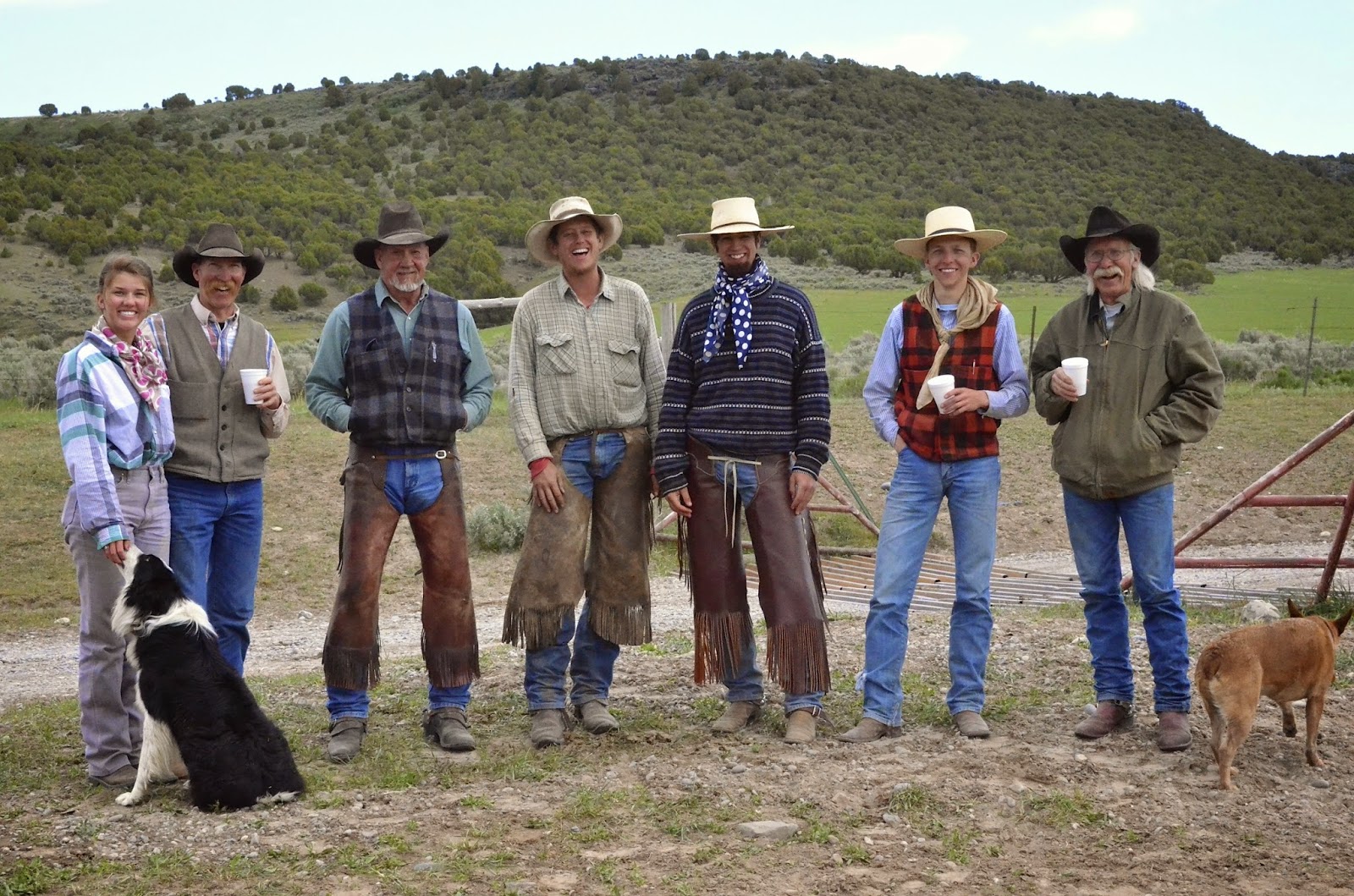
the crew